

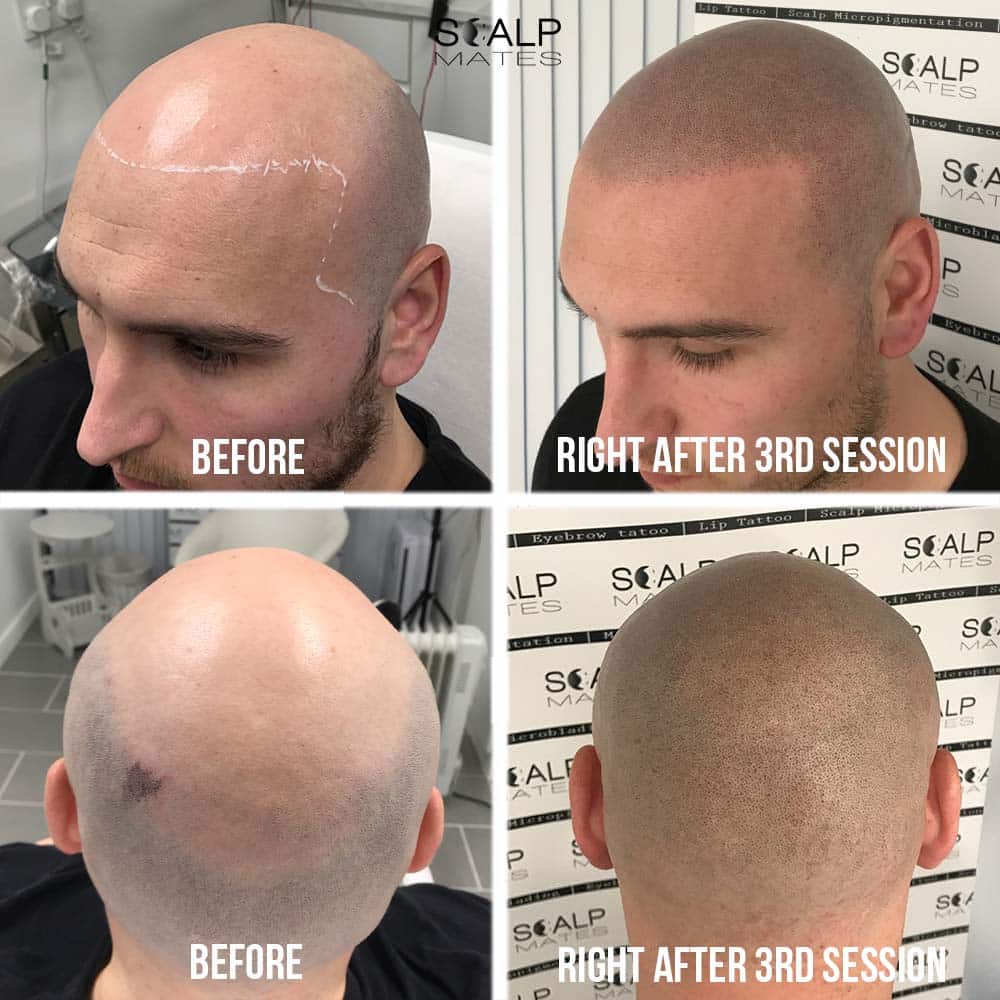
360° shaved look scalp micropigmentation transformation completed over 3 sessions at Scalp Mates Birmingham using pure organic Nocturnal Ink.
👋 A Note from Your Practitioner
“When you’re experiencing hair loss, shaving your head can feel like giving up. But a professional shaved look scalp micropigmentation treatment transforms a receding hairline or thinning crown into a sharp, deliberate buzz cut. In my Birmingham SMP clinic, my goal isn’t just to deposit pigment—it’s to build an undetectable, realistic hairline that complements your facial structure and gives you back 100% daily confidence.”
What is Shaved Look Scalp Micropigmentation?
Shaved look scalp micropigmentation (SMP)—often referred to as a hairline tattoo for shaved heads—is an advanced, non-surgical treatment designed specifically for men dealing with male pattern baldness, receding hairlines, or diffuse crown thinning.
Unlike traditional body tattooing, which deposits heavy ink deep into the dermis, SMP uses ultra-fine micro-needles to place microscopic impressions of pure organic pigment into the upper dermis. Each dot replicates an individual, freshly shaved hair follicle stubble (Grade 0 or foil shaved), creating the optical illusion of a full head of dense hair cropped close by choice.
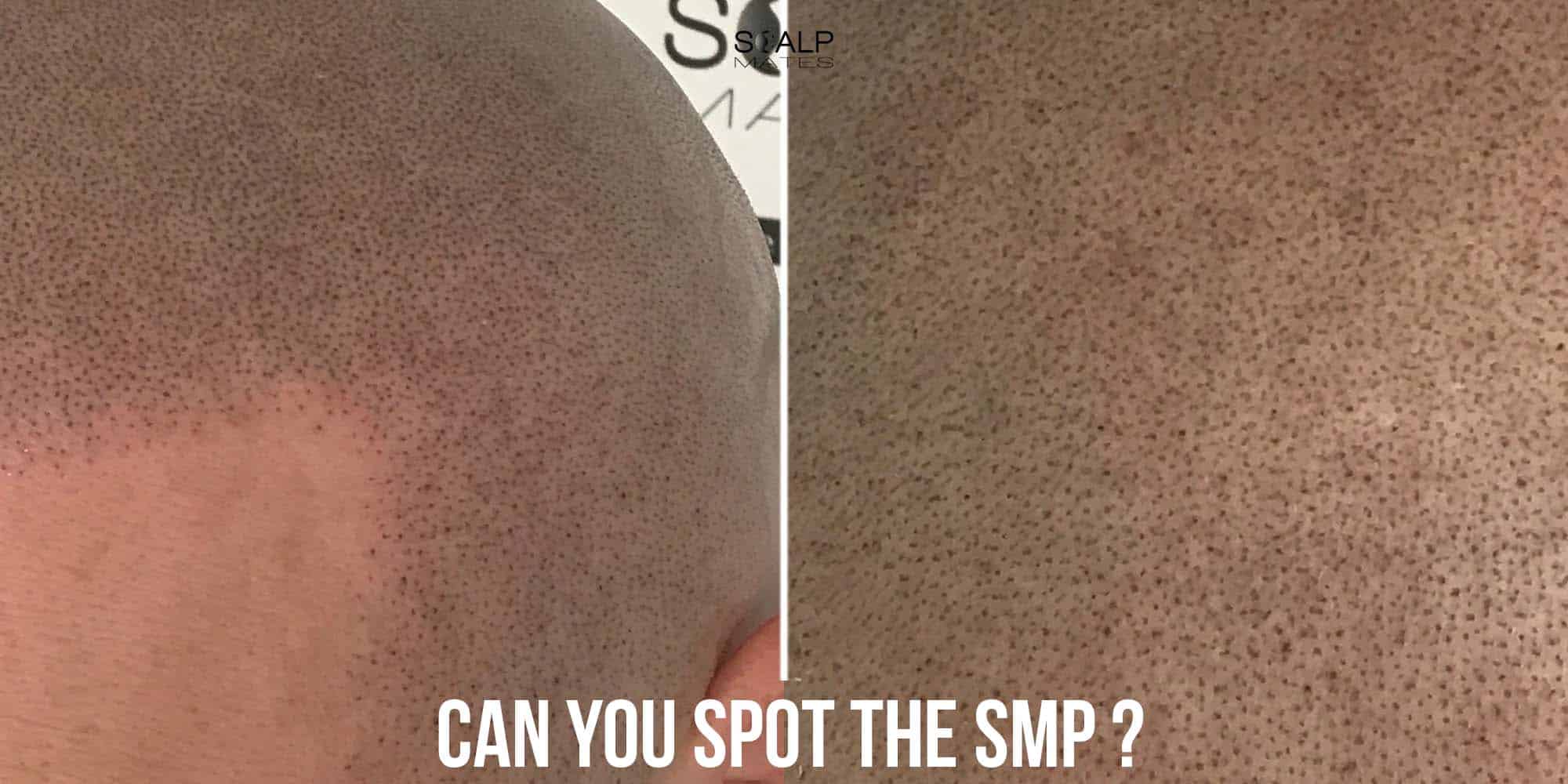
SMP Micro-impressions blend in seamlessly with the hair follicles
Who is the Ideal Candidate for a Shaved Hair Tattoo?
| Hair Loss Pattern | How SMP Solves It | Recommended Shaving Routine |
|---|---|---|
| Norwood 3 to 7 Baldness | Reconstructs a full frontal hairline, temples, and crown density. | Foil shaver or zero-clipper every 2–3 days. |
| Diffuse Thinning | Adds background shadow contrast between remaining hairs to eliminate scalp glare. (For longer hair styles, see our long hair density SMP guide). | Kept short (0.2mm to 0.5mm) for seamless 3D/2D blending. |
| FUE / FUT Transplant Scars | Camouflages donor area extraction dots and linear scars back into surrounding hair density. | Tight fade or crop on back and sides. |
| Alopecia Areata / Totalis | Restores total head follicle coverage across hairless scalp areas. | Daily clean shave or foil shaver. |
Real Studio Discussions: Overcoming Pre-Treatment Doubts
Sitting face-to-face with clients at ScalpMates over the years, I’ve noticed that nearly everyone arrives with similar raw worries and questions. Addressing these upfront is the best way to feel confident before booking.
💬 “I spent years on hair powders, sprays, and pills. Will SMP actually look real?”
Real Client Scenario: A client in his early 30s spent over £3,000 on hair loss shampoos, concealers, and meds over four years. He sat on the fence about SMP for months out of fear that a hair tattoo would look fake or like a dark helmet.
The Outcome: During his consultation, we looked at close-up healed work under direct lighting. By using sterile 3-point 0.22mm precision needles and organic carbon ink, each dot mimics real hair stubble. His verdict after Session 2? “I wasted four years stressing in front of the mirror every morning when I could have just shaved it down and had a permanent answer.”
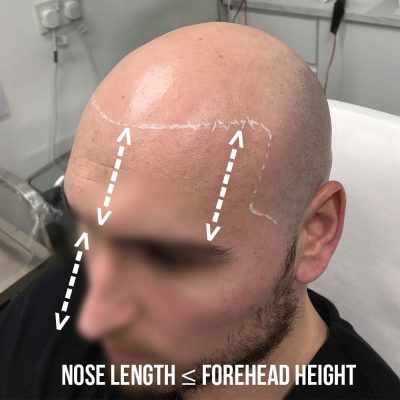
Facial symmetry rule: Forehead height must always remain equal to or greater than nose length for a natural, balanced hairline.
The Art & Science of Hairline Placement: Preserving Facial Symmetry
One of the biggest mistakes an inexperienced SMP technician can make is placing a hairline too low on the forehead. While it can be tempting for a client to request the low hairline they had in their teens, forcing an artificially low line breaks natural facial harmony and shrinks your facial proportions.
At ScalpMates SMP studio, every hairline mapping follows proven aesthetic rules based on facial golden ratios and natural muscle movement.
1. The Golden Rule: Nose Length vs. Forehead Height
The human face is naturally divided into three equal vertical sections: from the chin to the base of the nose, from the nose to the brow line, and from the brow line to the hairline.
My Clinical Rule for Forehead Proportions:
“To maintain true facial harmony, forehead height should always be equal to or greater than nose length. Bringing a hairline lower than the length of your nose shrinks the upper third of your face, drawing unnatural focus to the forehead and throwing off your entire facial balance.”
2. Designing a Natural, Mature Recession at the Temples
Even if you prefer a sharp or structured shape-up, a 100% natural hairline should never run dead straight across the forehead into the temples like a flat ruler.
As men mature, natural hairlines naturally recede and creep upward slightly at the corners (the temporal peaks). During our consultation, or 1st micropigmentation session, we map this subtle upward curve into the pencil mockup:
- Following Forehead Muscle Lines: I ask you to raise your eyebrows so we can see where your upper forehead muscles end. Placing pigment on active muscle tissue looks unnatural when you make facial expressions.
- Soft Temporal Corners: Allowing the hairline to rise naturally at the corners mimics authentic male hair growth, ensuring your treatment looks age-appropriate today, 5 years from now, and 10 years down the line.
- Custom Micro-Feathering: The leading edge along the center and corners is feathered with lighter micro-impressions so there is zero harshness where skin meets pigment.
Choosing Your Hairline Style: Which Look Suits You Best?
Designing your hairline is one of the most critical parts of your Micropigmentation journey. Your hairline creates the visual frame for your entire face, and choosing the right style depends on your natural hair type, skin tone, facial features, and personal aesthetic goals. (Explore our gallery of before and after SMP for men to see real-world transformations).
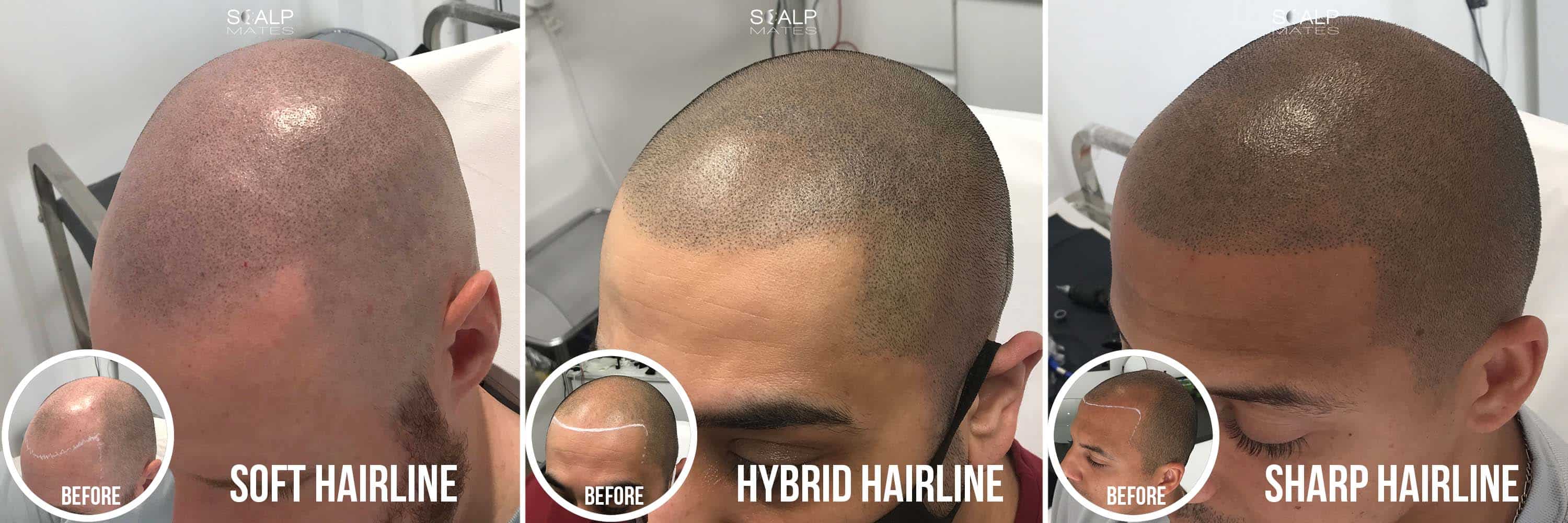
Comparison: Soft Feathered Hairline vs. Hybrid Hairline (Center) vs. Sharp Shape-Up Hairline
1. The Soft Feathered Hairline
The soft feathered hairline uses scattered, broken micro-impressions along the leading edge. Instead of a solid line, the pigment gradually fades away into the skin, mimicking a completely natural, untouched hairline.
- Who it suits best: The vast majority of Caucasian clients prefer this option because it offers an age-appropriate, 100% undetectable finish. It is ideal for anyone who wants to restore their frame without making it obvious they’ve had a procedure done.
- Cultural & Style Focus: An overly sharp, straight line on fair skin can instantly attract attention and raise questions. A soft feathered hairline ensures zero suspicion from friends or colleagues. Many Asian men also specifically request this style when their primary goal is a subtle, natural result that leaves no doubt about its authenticity.
- The “Gangster” Aesthetic Exception: While most white clients opt for a soft edge, those looking for a bolder, rugged “gangster” aesthetic may choose a sharper, more defined hairline instead—especially when paired with strong facial features, a defined jawline, or a sharp, well-groomed beard.
2. The Soft-to-Sharp Hybrid Hairline
The hybrid hairline strikes a middle ground. It maintains clean, structured side temples and a defined overall shape, but subtly softens the very front edge so it doesn’t look stencil-drawn.
- Who it suits best: This is the most popular choice overall—particularly among Asian clients and men who want their hairline shape to be clearly visible without appearing harsh.
- Why it works: Soft hairlines can sometimes feel a bit too subtle for clients who want a fresh “just walked out of the barbershop” look. The hybrid style gives you the visible framing of a shape-up while preserving enough edge softness to keep people guessing.
3. The Sharp / Boxed Shape-Up Hairline
The boxed shape-up hairline features crisp edges, defined temporal corners, and tighter dot density along the leading boundary to replicate a fresh barber lineup.
- Who it suits best: Requested by the vast majority of Black/Afro-Carib clients, as well as men with darker skin tones who favor a clean, structured barber finish. Very few Black clients request a soft feathered line.
- The Science Behind the Shape-Up: Understanding skin contrast is crucial here. The darker the natural skin tone, the more defined and sharp the hairline boundary must be to remain visible. On darker skin, a feathered or overly soft hairline tends to blend into the skin’s background melanin, making the hairline look faded or incomplete. Going sharper creates the necessary contrast to make the profile pop naturally.
💡 Practitioner Tip: Finding Your Perfect Balance
“During Session 1 in my clinic, we draw your hairline using a wax pencil and adjust the height, corners, and curvature until you are 100% happy. Remember: we can always start slightly softer in Session 1 and sharpen the edges during Session 2 or 3 once you see how your skin heals!”
Equipment & Safety: Organic Inks & Sterile Needles
Your long-term healed result relies heavily on equipment quality and hygiene standards:
- Pure Organic Nocturnal Ink: I work exclusively with high-grade organic carbon ink. It contains no synthetic dyes or acrylic additives, ensuring it lightens naturally into a soft charcoal shade over the years without shifting into blue or green tones.
- 0.22mm Precision Micro-Needles: Every treatment is performed using single-use 3-point 0.22mm sterile needle cartridges. Each pack is sealed at the factory and opened right in front of you before your session begins.
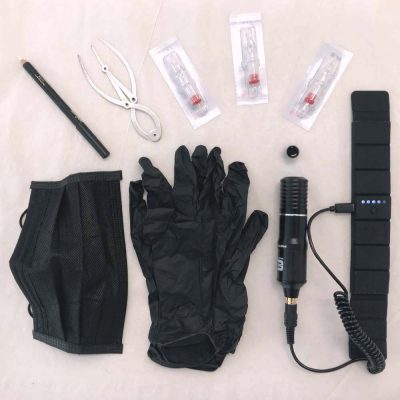
100% single-use, medical-grade sterile needle cartridges opened fresh for every client.
The Step-by-Step Journey: How a Hair Tattoo for Balding Builds Over 3 Sessions
Getting a hair tattoo as a male is never a one-and-done procedure. Scalp micropigmentation is a controlled, layered process designed to build depth and density safely without over-working the skin or creating a harsh, unnatural block of color.
By spacing your treatment out over three separate visits, we ensure that each layer heals completely, allowing us to tweak shade tone, hairline placement, and dot density until the result is 100% seamless.
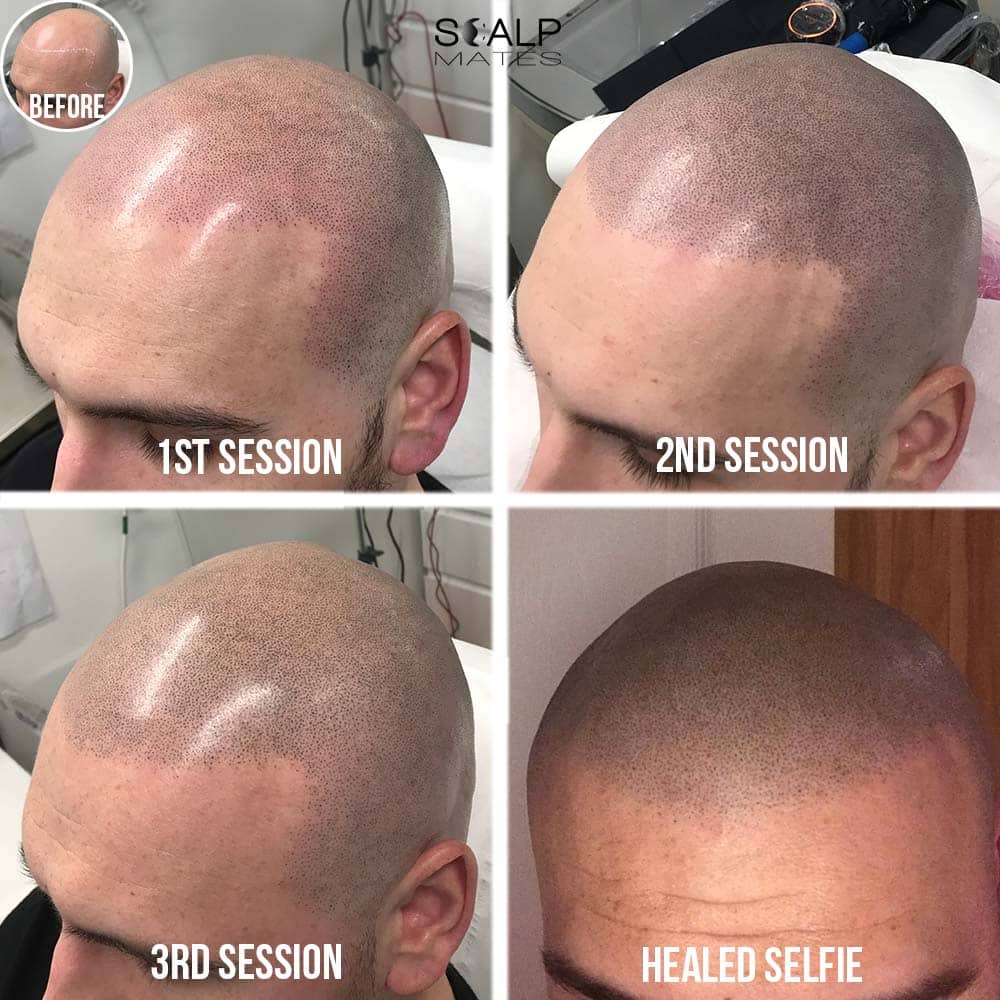
Step-by-Step SMP Layering: Before → Session 1 Base → Session 2 Density → Session 3 Perfecting → Healed Client Selfie.
Session 1: Mapping the Hairline & Building the Base Foundation
During your first visit, we spend significant time custom-drawing your new hairline with a wax pencil, adjusting height and symmetry until you are completely confident in the shape. Once mapped, we begin laying down the initial base layer.
- Light & Conservative: We deliberately start with a lighter pigment shade and wider dot spacing. This establishes the structural framework of your new hairline and crown density while testing how your skin retains the pigment.
- Immediate Post-Session Redness: Immediately after Session 1, you will notice slight skin pinkness or redness around the treatment area. Don’t panic! This is completely normal skin vascularization. For the vast majority of clients, this mild redness settles down significantly overnight and goes away by the next day, allowing you to go about your week comfortably.
Session 2: Building Bulk Density & Matching Shade Tone
Performed 10 to 14 days after Session 1, this visit is where the transformation truly comes to life. The bulk of the visual density work is executed across Sessions 1 and 2.
- Filling the Gaps: I place fresh micro-impressions between the healed dots from Session 1, significantly darkening the overall shade to match your natural hair stubble on the sides and back.
- Tightening the Shape: We refine the frontal edge and temples, giving your hair tattoo for a bald man a clean, structured appearance.
Session 3: Perfecting, Blending & Final Micro-Refinements
Held 10 to 14 days after Session 2, your final visit is all about perfectionism. While the majority of the coverage is already established, Session 3 allows us to step back and evaluate the healed result under direct studio lighting.
- Micro-Blending: I inspect the entire scalp for any tiny lighter patches or subtle texture gaps, adding extra micro-dots to ensure a 100% uniform, natural gradient. View our full gallery of SMP results in Birmingham to see completed transformations.
- Adding Darker Contrast (If Needed): If your skin healed lighter than expected, we can add a touch more shade depth during this session to lock in optimal contrast against your skin tone.
- Final Healed Result: Once Session 3 heals over the next 7 to 10 days, any slight surface redness disappears completely, leaving behind a realistic, natural-looking shaved head profile.
💡 Practitioner Insight: Understanding Post-Session Redness
“When you look in the mirror straight after your session, the scalp will appear slightly red and the dots may look darker than expected due to surface blood flow. In 90% of cases, the redness goes away by the very next day. Over the following week, surface pigment washes away, leaving behind a smooth, perfectly settled follicle impression.”
Real Studio Discussions: Pain, Redness & Aftercare
💬 “How painful is it really (1–5 scale), and what about redness on Monday?”
The Pain Factor: Most clients rate discomfort at a mild 2 out of 5. It feels like a light tapping on the scalp. While the hairline and temples can feel slightly more sensitive, sessions move quickly with comfortable breaks.
However, not everyone is built the same, with some people being significantly more sensitive. I do have an anesthetic (numbing) cream if SMP becomes too uncomfortable.
Post-Session Redness: Light pinkness immediately after a session is completely normal. For 90% of clients, this settles within 12 to 24 hours. A Friday afternoon session means you can walk into work on Monday looking clean with zero obvious irritation.
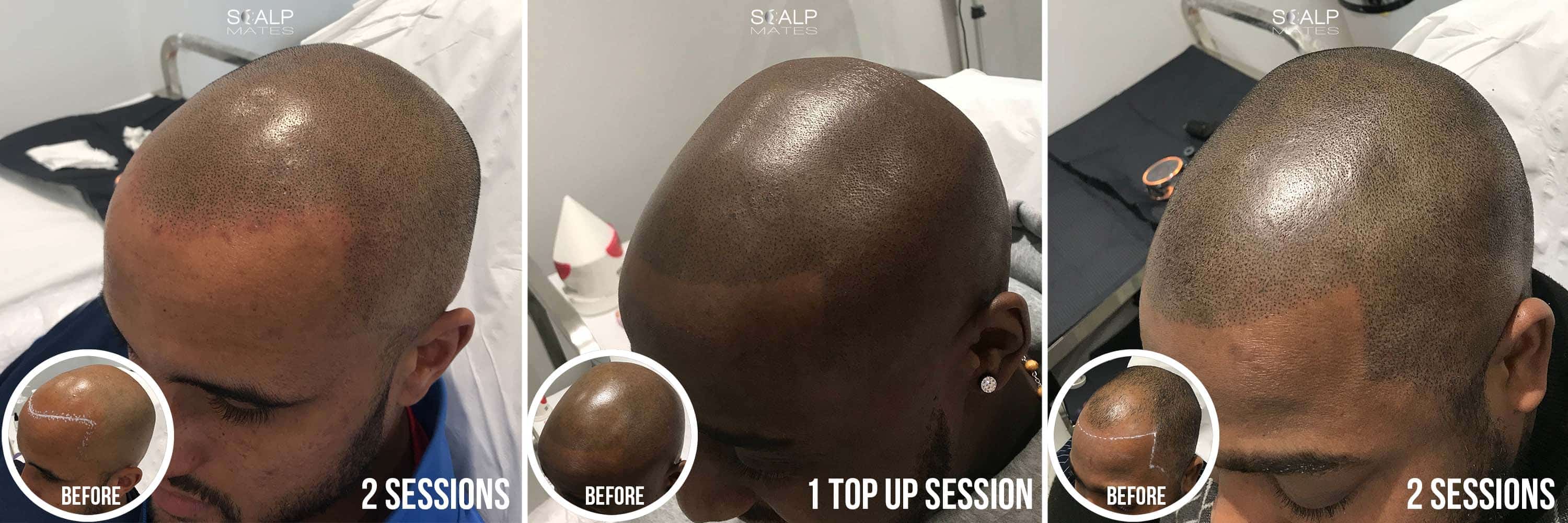
Specialized hair tattoo for black skin: Custom shape-up line-ups designed for Afro-textured hair and darker skin tones at Scalp Mates Birmingham.
Specialized Hair Tattoo for Black Skin & Afro-Carib Hairlines
Performing a hair tattoo for black skin requires an expert understanding of skin undertones, contrast limits, and natural follicle geometry. When treating Afro-textured hair, the objective is to replicate the crisp, fresh “barber line-up” shape that defines a classic buzz cut while maintaining realistic skin harmony.
1. Why Darker Skin Tones Require a Sharper Shape-Up
While Caucasian or fair-skinned clients usually opt for soft, feathered edges to avoid looking overly harsh, very few Black clients request a soft hairline. On darker skin tones, a feathered or overly soft hairline tends to melt into the skin’s natural melanin background, making the treatment look faded or incomplete.
To make the hairline clearly visible against dark skin, we typically build a sharper, boxed shape-up. Structuring a clean, defined boundary creates the necessary visual definition for the hairline to frame your face properly.
2. The Truth About Pigment Depth & Skin Contrast
A crucial detail every client with dark skin must understand is the reality of pigment tone versus skin melanin. Even when a hairline is shaped up to its maximum definition, the darker the natural skin tone, the subtle and lower the visual contrast will naturally be.
- Pigment Dilution in Skin: The darkest, most concentrated pigment shade we use is black. However, once deposited into the dermal layer, the pigment sits underneath the skin’s surface and mixes with natural skin undertones and tissue fluid. Because of this, healed SMP never heals as a harsh, jet-black paint—it heals as a rich, dark charcoal stubble tone.
- Realistic Expectations: On very dark brown or deep melanin-rich skin, the healed pigment will subtly blend into your natural skin background rather than standing out with stark white-and-black contrast. It builds a clean, authentic shadow that frames your forehead naturally without looking fake or painted-on.
3. Avoiding the “Helmet Effect” & Preventing Keloid Scarring
- Custom Organic Shade Blending: Over-saturating dark skin with thick, heavy pigment to force a pitch-black line creates an unnatural, blocky “helmet” effect. In my ScalpMates SMP studio, I use organic Nocturnal carbon ink, carefully adjusting density across Sessions 1 and 2 to ensure a clean, natural finish.
- Keloid-Safe Technique: Melanin-rich skin can be prone to keloid tissue or irritation if worked too aggressively. By using ultra-fine 3-point 0.22mm precision needles and controlled, light depth, I deposit pigment safely into the upper dermis without damaging surrounding skin tissue.
💡 Practitioner Insight: Setting Honest Expectations for Dark Skin
“I always tell my Black clients straight: we will give you a clean, crisp shape-up, but we will never force pigment to look jet-black. Pigment sits under your skin’s melanin, meaning the darkest shade heals as a clean, natural dark charcoal stubble. This preserves realism, avoids a blocky helmet look, and guarantees a result you can wear with complete confidence.”
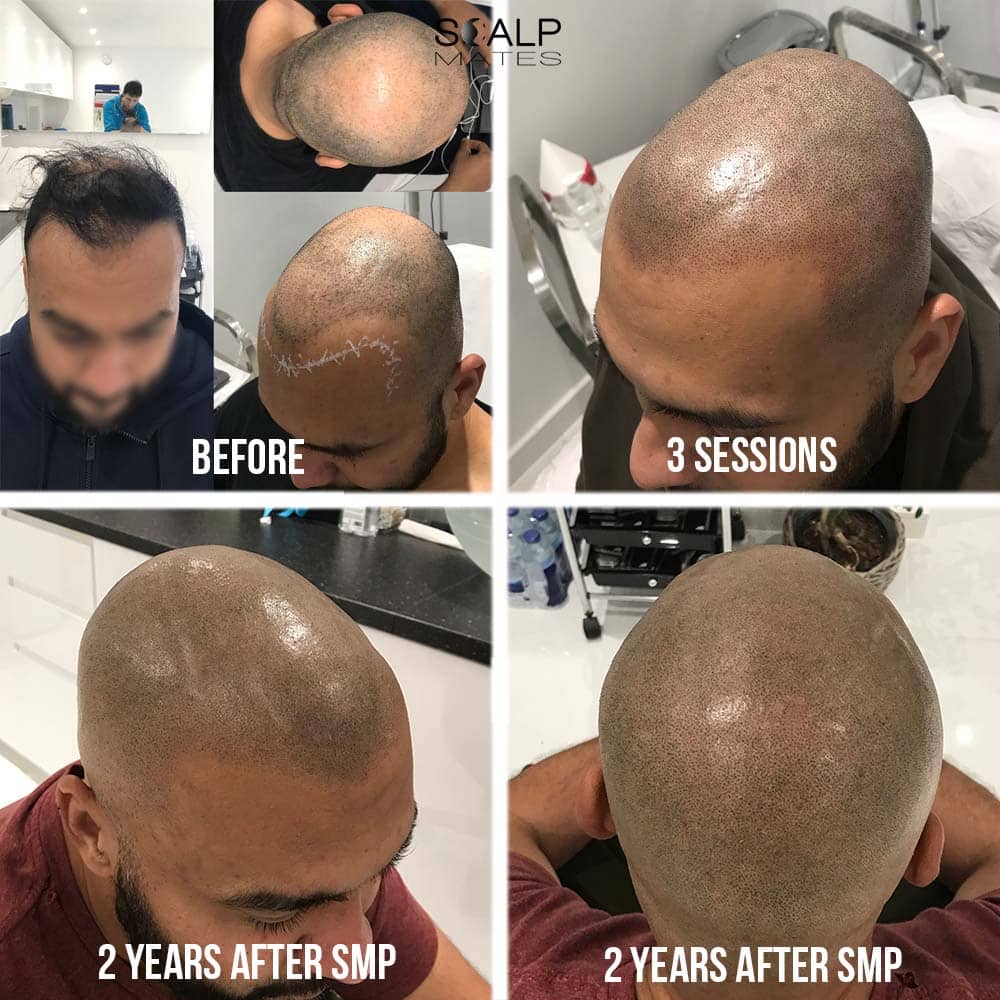
From thin, see-through transplant strands to a dense shaved look: 3 sessions progression and 2-year healed result at Scalp Mates Birmingham.
Precision Scalp Micropigmentation for Asian Hair Types & Failed Hair Transplants
Asian hair typically features straight, coarse follicles with strong natural density, paired with skin carrying warm, golden, or olive undertones. Achieving a seamless match requires specific contrast control, especially when repairing sparse coverage left behind by previous surgical procedures.
Case Study: Moving From a Failed Hair Transplant to a Clean Shaved Look
I see cases like this all too often at ScalpMates. This client previously underwent a hair transplant hoping to restore his youthful hairline, but like many surgical procedures on diffuse hair loss, the density fell far short of expectations.
He was left with thin, patchy coverage across the top, constantly trying to style a few wispy strands of hair to hide his scalp. Every morning was a battle against mirrors and wind, trying to keep sparse hairs positioned over thinning areas.
The Client’s Realization:
“He finally got sick of stressing over a few thin strands of hair and decided to shave it all down to commit to a clean shaved look. After three sessions of scalp micropigmentation, we rebuilt a full, natural hairline and crown density that seamlessly blends into his coarse Asian hair roots. He told me he’s never looked back—his only regret was putting himself through the hassle, cost, and recovery of a hair transplant in the first place instead of coming straight for SMP.”
Key Considerations for Asian Skin Tones & Transplant Repair
- Matching Coarse Stubble Density: Asian hair stubble appears dark against scalp skin. We build density across Sessions 1 and 2 to create a natural background shadow that completely camouflage diffuse thinning gaps.
- Zero Color Shifts on Olive Skin: Traditional body inks can shift ash-blue or green under warm or olive skin undertones. Using pure organic Nocturnal carbon ink ensures the pigment ages into a clean grey charcoal tone matching natural hair roots. As you can see in his 2-year healed photos above, the tone remains crisp, natural, and completely stable over time.
- Soft Temple & Hybrid Hairline Blending: We feather the temporal corners so the new hairline merges naturally into his side profile, giving him a clean, undetectable finish that avoids raising questions among family or colleagues.
💡 Practitioner Insight: Why Shaving Down Beats Chasing Transplant Density
“Surgical hair transplants have a hard limit on donor hair availability. Trying to spread limited grafts across a broad, thinning top often results in see-through coverage. Shaving down and filling those gaps with organic SMP delivers instant, 100% optical density without surgery, downtime, or endless daily styling stress.”
Is Scalp Micropigmentation Permissible for Muslims? (Halal Considerations)
Many of my clients in Birmingham are practicing Muslims who ask whether scalp micropigmentation is permitted in Islam before booking. Here is how SMP differs from traditional body tattooing:
- Restoration vs. Alteration (Al-Tadawi): In Islamic jurisprudence, procedures intended to restore hair lost to genetics, illness, or scarring are viewed as medical restoration (Al-Tadawi) rather than unnecessary body alteration. Scholars note that restoring a defect back to its natural state is permissible.
- Wudu & Ghusl Water Permeability: Body tattoos sit deep and can raise concerns about water reaching the skin during ablution. SMP deposits microscopic carbon dots into the upper dermis without forming a waterproof barrier on top. Water reaches and cleanses the scalp normally during Wudu and Ghusl.
- Pure Organic Ingredients: Organic Nocturnal Ink is 100% carbon-based and free from animal-derived ingredients or synthetic additives.
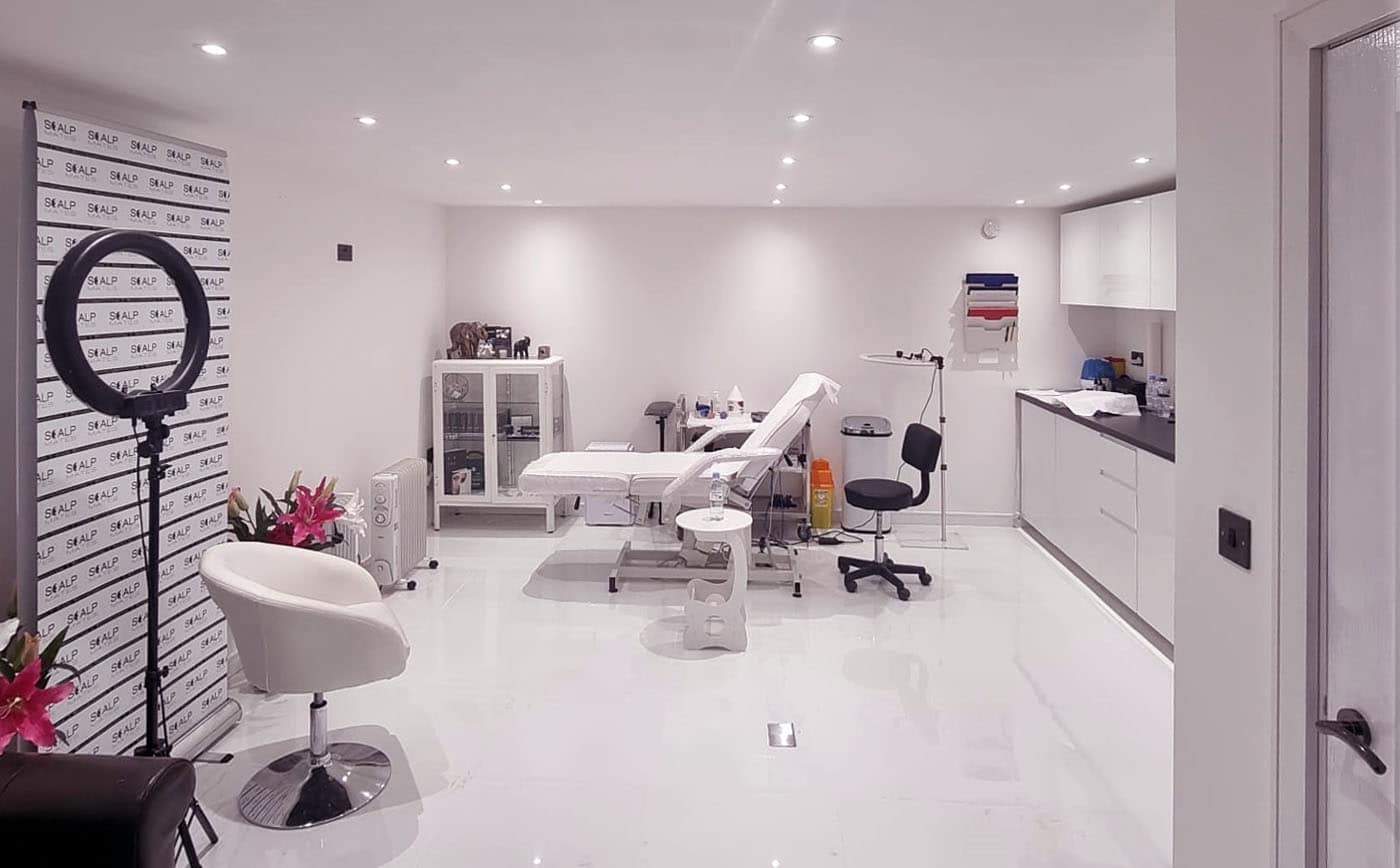
Private, welcoming studio setting in Birmingham / Where the magic happens.
The Golden Rule of Maintenance: SMP Hair Length & Shaving Routine
For a shaved look scalp micropigmentation treatment to look 100% realistic, maintaining proper hair length is key. While SMP builds an incredible 2D illusion of dense follicle stubble, your natural hair continues to grow as 3D hair strands.
In my Birmingham ScalpMates clinic, I often use the real-world client comparison below for educational purposes to demonstrate how hair growth affects your overall blend.
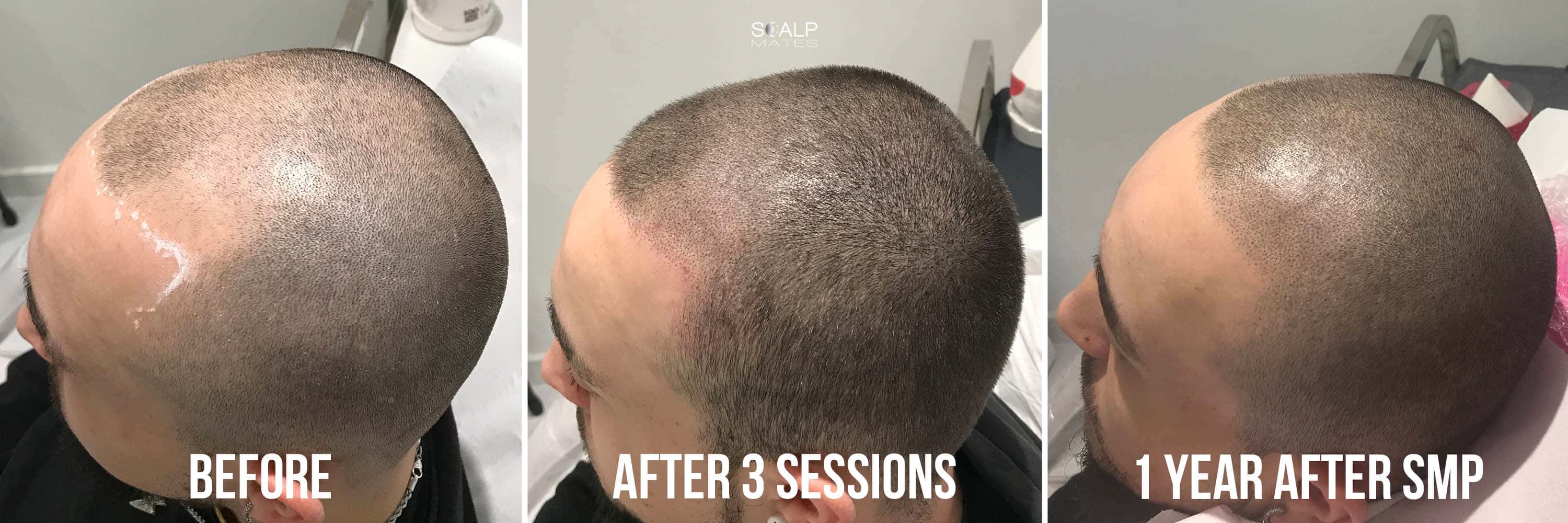
Educational Case Study: Before treatment (Left), 3 sessions completed with 7 days hair growth (Center), and 1 year healed result cleanly shaved with a foil shaver (Right).
Educational Comparison: 7 Days Hair Growth vs. Foil Shaved Result
Normally, I require clients to arrive for their sessions with a cleanly shaved scalp. However, in this specific case, the client arrived with almost a week’s worth of hair growth (~7 days growth / 2mm+ length).
Rather than shaving him down immediately, I agreed to add slightly more bulk and density safely across the balding areas to give him a bit extra leeway for those weeks when he doesn’t feel like shaving daily.
- The Reality of 7 Days Growth (Center Panel): Realistically, 2D micro-dots can never fully blend into longer 3D hair strands on a completely bald area. However, even with a week’s hair growth, the extra density we built still massively reduces scalp contrast, making the hair loss far less noticeable from a distance.
- The Undetectable Foil-Shaved Result (Right Panel): As you can see in his 1-year follow-up photo, when he shaves his scalp down close with a foil shaver, the treatment locks in seamlessly. The micro-impressions blend perfectly into his natural side stubble, rendering the hairline 100% realistic and completely undetectable—a stability that lasts reliably for 2 years and beyond.
Note: This comparison is purely for educational purposes! Life gets busy, and it’s completely normal to go a few extra days without shaving. Your treatment will still hold its frame across the room, but keeping it short unlocks its true 3D realism.
Recommended Shaving Tools & Schedules for the Best Blend
| Shaving Tool | Cutting Height | Recommended Frequency | Blending Effect |
|---|---|---|---|
| Electric Foil Shavers (Pitbull, Wahl, Babyliss Pro) |
0.1mm – 0.2mm | Every 2 to 3 Days | Flawless / Undetectable. Matches 2D dots flush to skin level. |
| Zero Clippers / Trimmers (Grade 0) |
0.5mm | Every 1 to 2 Days | Strong Blend. Keeps hair below the 0.5mm texture threshold. |
| Wet Razor Shaving (Safety Razor) |
0.0mm | Every 3 to 4 Days | Side Fade Look. Bare skin sides transition smoothly into top micro-dots. |
💡 Practitioner Rule: The 0.5mm Hair Length Threshold
“If your natural hair grows past 0.5mm, 3D hair strands begin casting slight shadows against flat pigment dots. While it still looks great at a casual glance across a room, taking 2 minutes every few days to run an electric foil shaver over your scalp guarantees that your SMP remains 100% invisible up close.”
Real Studio Discussions: Is SMP Worth It Long-Term?
💬 “How long will it last, and do clients ever regret getting it?”
Longevity & Fading: A completed 3-session treatment typically lasts 2-4 years before needing a touch-up. Organic Nocturnal Ink softens naturally into a clean charcoal tone without discolored fading.
Honest Regrets: When I catch up with clients a year post-treatment, their response is overwhelmingly positive. The most common regret I hear? “I only wish I stopped wasting money on hair fibers and hats and just did this three years sooner.”
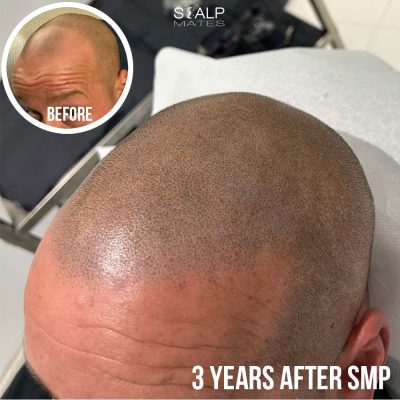
Real 3-year healed result with zero color shifting or blurriness.
Frequently Asked Questions
Will people be able to tell I had a hair tattoo?
When performed using fine 0.22mm precision needles, SMP is virtually undetectable to the naked eye—even close up. Most friends notice that you look younger or cleaner without realizing you had a procedure done.
How much does shaved look scalp micropigmentation cost in Birmingham?
Cost depends on your stage of hair loss (Norwood scale 2 to 7). A full 3-session treatment ranges between £400 and £1200. All quotes include all three sessions, custom hairline design, and full aftercare support. Please visit our SMP PRICELIST for a detailed cost breakdown.
What happens if I go fully grey in my 40s or 50s?
Because organic Nocturnal Ink is carbon-based, it lightens naturally into a soft grey charcoal shade over time. Natural grey hair stubble is dark at skin level, meaning your SMP continues blending seamlessly as you age.
How do I protect my treatment from sun fading?
Extreme, all-day sun exposure (like working outdoors daily without a hat) accelerates fading. Wearing a cap or applying SPF 30+ in intense heat protects the pigment. Don’t stress over normal everyday sun—walking to your car or an afternoon outdoors won’t ruin your treatment!
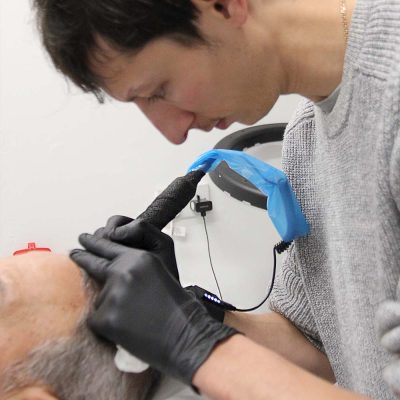
Hi, I’m Laurentiu Bradea
Lead SMP Artist at Scalp Mates Birmingham
Having personally treated well over 500 clients since 2019, I specialize in creating ultra-realistic, undetectable shaved look scalp micropigmentation tailored to your exact facial features, skin tone, and hair type. Read more about ScalpMates or contact us online today.
Ready to discuss your hairline? Send me clear photos of your current hair loss over WhatsApp for a fast, personal estimate!