Does SMP Turn Blue or Green? See This Real Result 4 Years Later
One of the biggest fears people have about scalp micropigmentation is waking up a few years later with a blue or green hair tattoo. And I get it. Nobody wants to spend good money getting a natural-looking hairline, only to end up with something that looks like it belongs on a cartoon character.
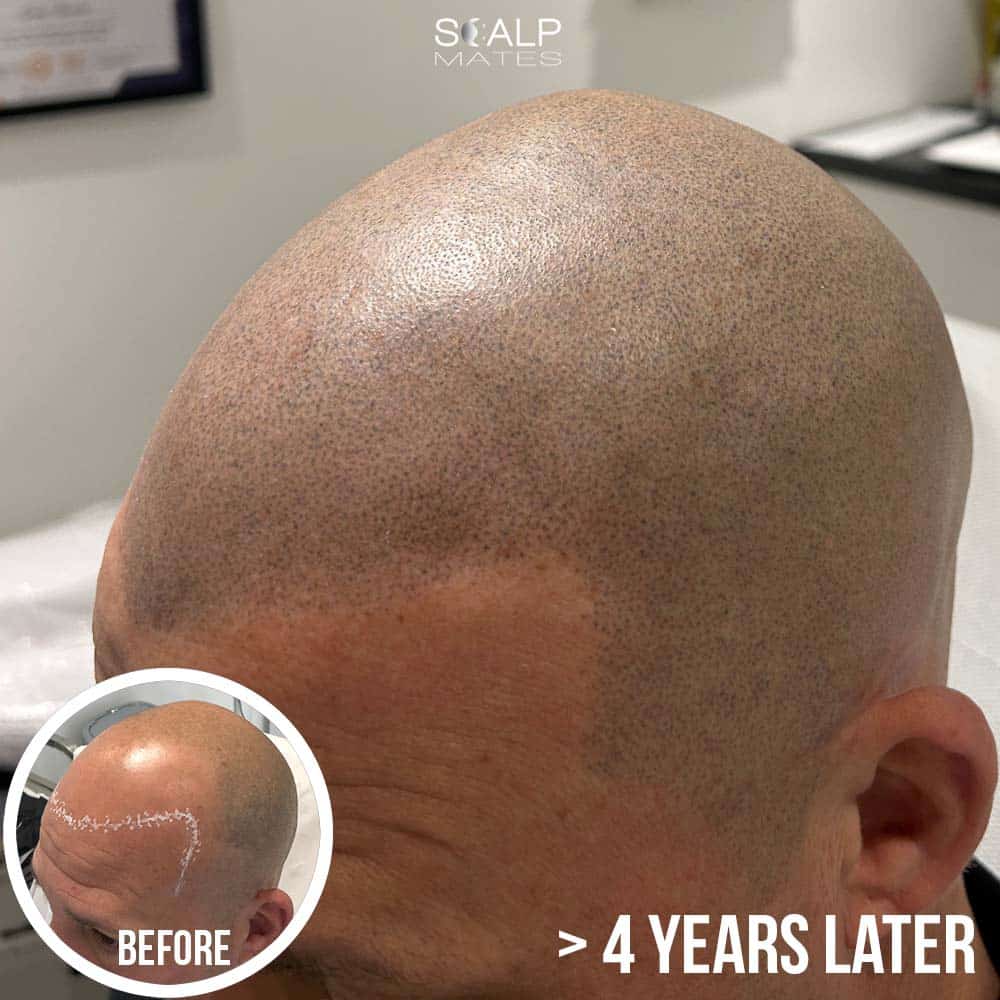
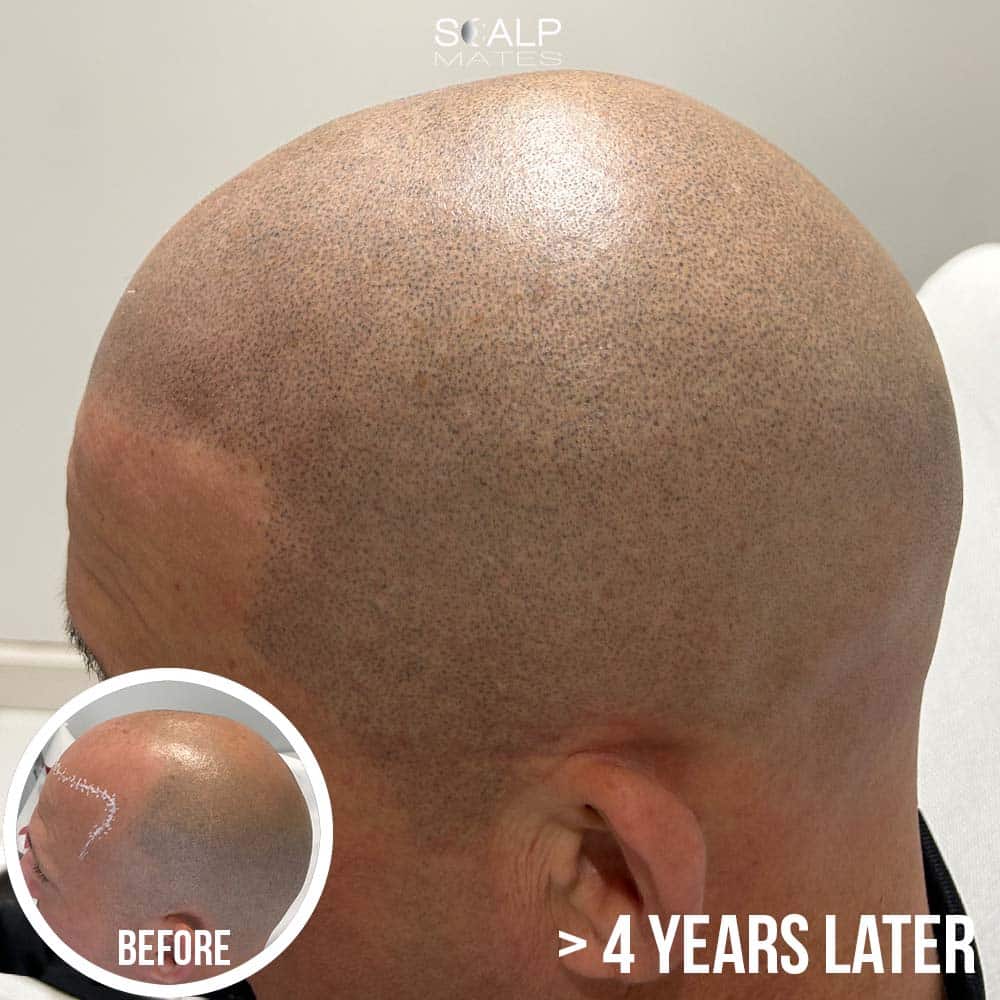
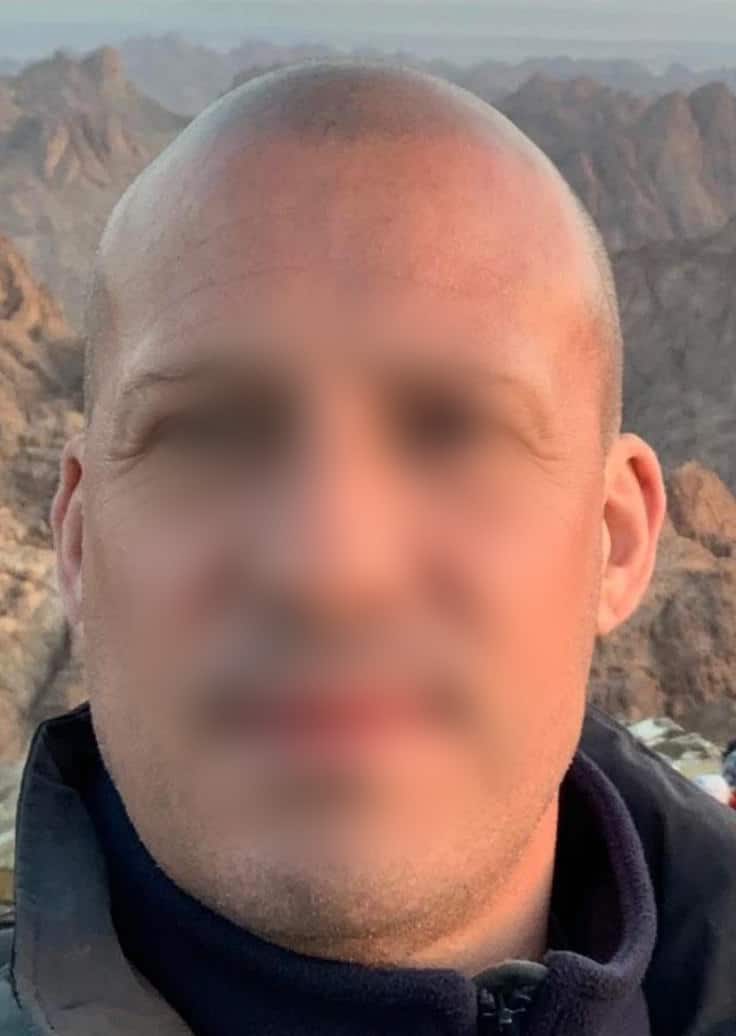
selfie sent just before booking his 2nd touch up in 2025
4-Year SMP Transformation Overview
So what actually happens to SMP after several years?
Does it change colour? Does it fade? Do the tiny dots stay sharp? And how often do you really need a touch-up?
Rather than just telling you how SMP should age, let me show you a real client I first treated back in July 2021.
He travelled from Coventry to my ScalpMates studio in Birmingham with quite advanced male pattern baldness.
Fast-forward to December 2025, and I had the chance to photograph his scalp again, more than four years after his original treatment and two years after his first maintenance touch-up.
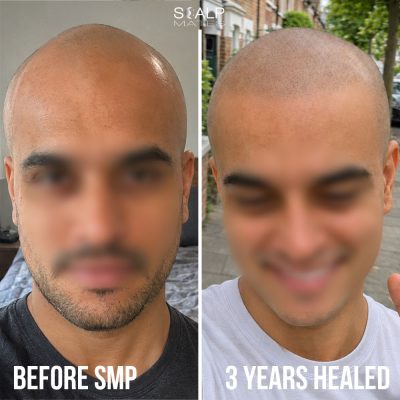
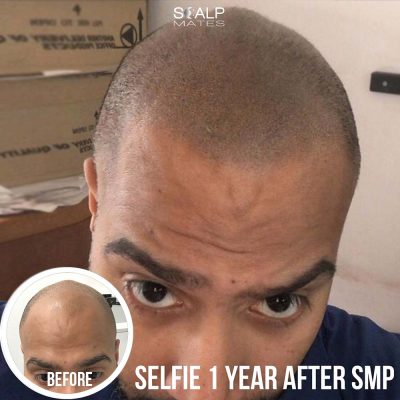
The result? A soft, natural-looking grey that blended nicely with his existing shaved hair. No visible blue or green discolouration.
Of course, there had been some fading and the individual pigment impressions weren’t quite as sharp as they had been originally.
That’s normal, and we’ll have a closer look at that too.
Quick Look at This 4-Year SMP Case Study
| Treatment information | Client details |
|---|---|
| Hair loss | Norwood 5–6 male pattern baldness |
| Age at first treatment | Early 40s |
| Skin tone | Fair-to-medium Caucasian skin, sometimes tanned |
| Existing hairstyle | Very closely shaved with a foil shaver |
| Desired result | Natural, slightly V-shaped hairline and full top coverage |
| Client location | Coventry, West Midlands |
| Initial treatment | July–August 2021 |
| Initial sessions | 3 SMP sessions |
|
Equivalent 2026 initial cost |
£300 per session (£900 total) |
| First maintenance touch-up | December 2023 |
| Second maintenance touch-up | December 2025 |
| Equivalent 2026 touch-ups cost | £200 each (£400 total) |
| Total equivalent cost |
£1,300 over approximately 4½ years |
| SMP practitioner | Laurentiu Bradea (Laur), ScalpMates Birmingham |
So, Does Scalp Micropigmentation Actually Turn Blue or Green?
Let’s answer the main question first.
Well-performed scalp micropigmentation should normally heal and fade towards a softer grey appearance, rather than developing an obvious blue or green colour (learn more in our complete shaved look SMP guide).
However, that doesn’t mean unwanted colour changes are impossible.
Poor pigment selection, incorrect application depth and unsuitable techniques can all contribute to results that look unnatural as they age.
Skin tone, pigment formulation, sun exposure and the way the pigment settles over time can also affect its appearance.
So I wouldn’t tell anyone that SMP can never change colour.
What I can do is show you how my own work has aged.
And this particular client is a useful example because I have photographs from different stages over more than four years.
What Did His SMP Look Like After Four Years?
Look at the December 2025 photographs.
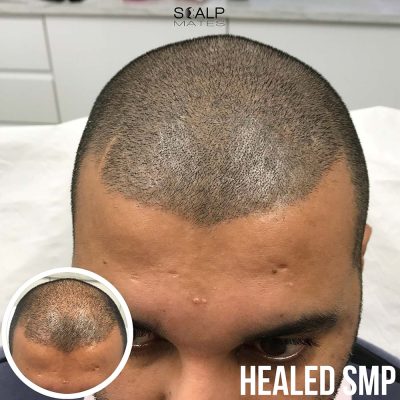
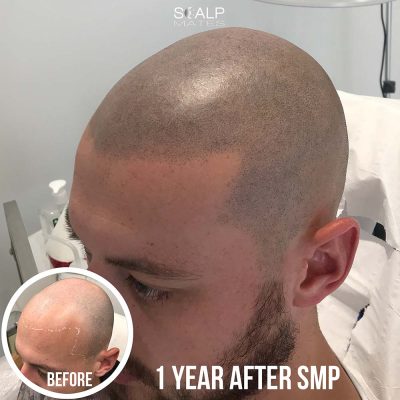
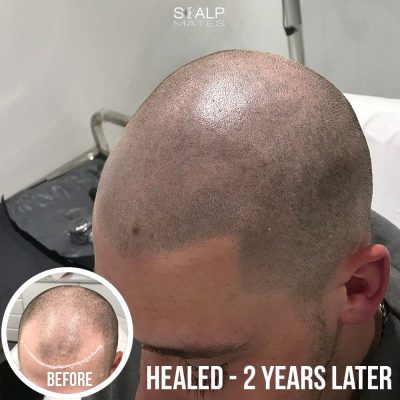
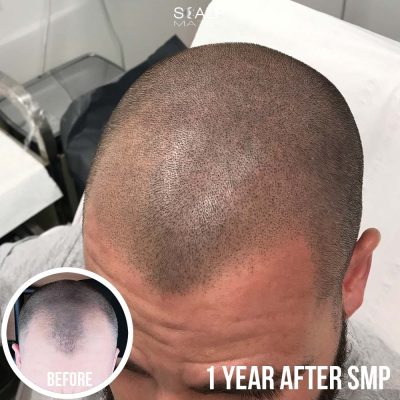
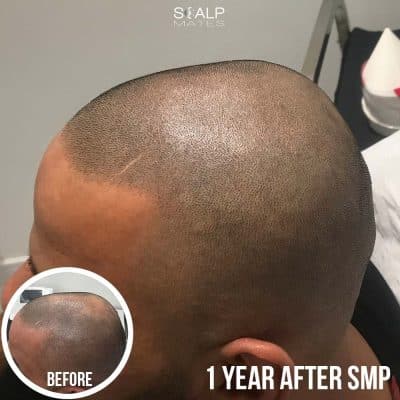
The pigment had settled into a light grey shade that blended very nicely with his natural shaved hair.
There was no obvious blue or green discolouration.
Some areas had become slightly lighter than others, and the pigment impressions had softened a little.
The individual dots weren’t as crisp as they were immediately after treatment, but the overall shaved-head appearance was still there.
And most importantly, he was still very happy with it.
These photographs were taken BEFORE I carried out his December 2025 touch-up.
I want to make that clear because it’s easy to show a freshly refreshed result and call it four-year-old SMP.
That’s not what we’re doing here.
The 2025 photos show how the previous work had actually aged.
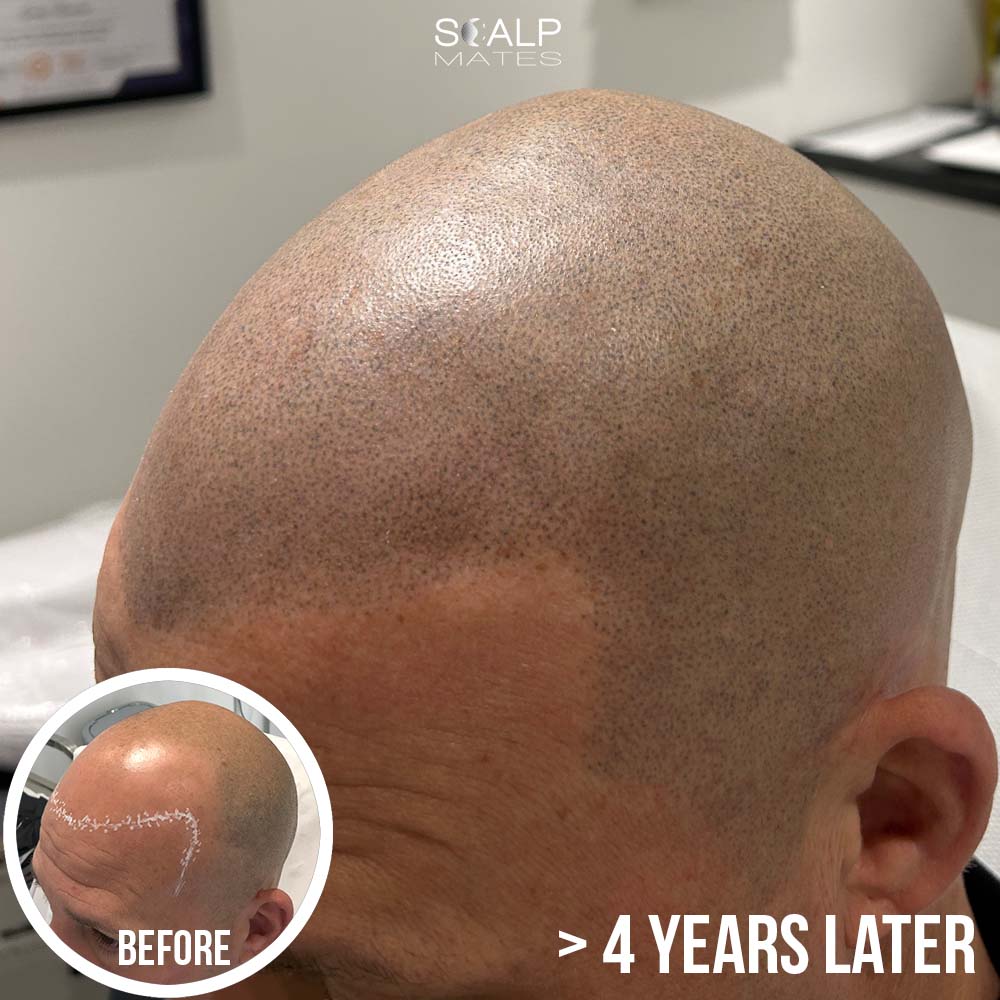 [More than 4 years after the original SMP treatment, photographed before the December 2025 touch-up.]
Let’s Go Back to 2021: Building His New Hairline
When this gentleman first came to me in July 2021, he had Norwood 5–6 hair loss.
Most of the hair across the top had disappeared, while he still had natural hair around the sides and back.
He was already keeping everything very short with a foil shaver.
His goal was straightforward.
He wanted the appearance of a full shaved head, with a realistic hairline that suited his face.
He particularly liked a slightly V-shaped hairline.
Not a sharp, perfectly straight line across his forehead, but something with a natural shape and a little character.
We worked on the design together and made small adjustments throughout the initial three sessions.
Why We Didn’t Try to Finish Everything in One Session
When I’m treating a larger area of baldness, I prefer building the pigmentation gradually (see our 3-session shaved head process guide for a full breakdown).
The first session creates the foundation.
The second adds more density and improves the blend.
And the third allows me to refine the hairline, fill any lighter areas and make the overall result more consistent.
This also gives the skin time to heal between appointments.
You can always add a little more pigment if needed.
Trying to correct a result that’s been made far too dark is a completely different story.
His skin was nice to work with, neither particularly oily nor dry.
He was relaxed throughout the treatment, and we spent plenty of time chatting about his work and other subjects.
He didn’t need a separate in-person consultation before booking.
As he was travelling from Coventry, we’d already discussed what he wanted, and he came straight in for his first session.
By August 2021, we’d completed all three appointments.
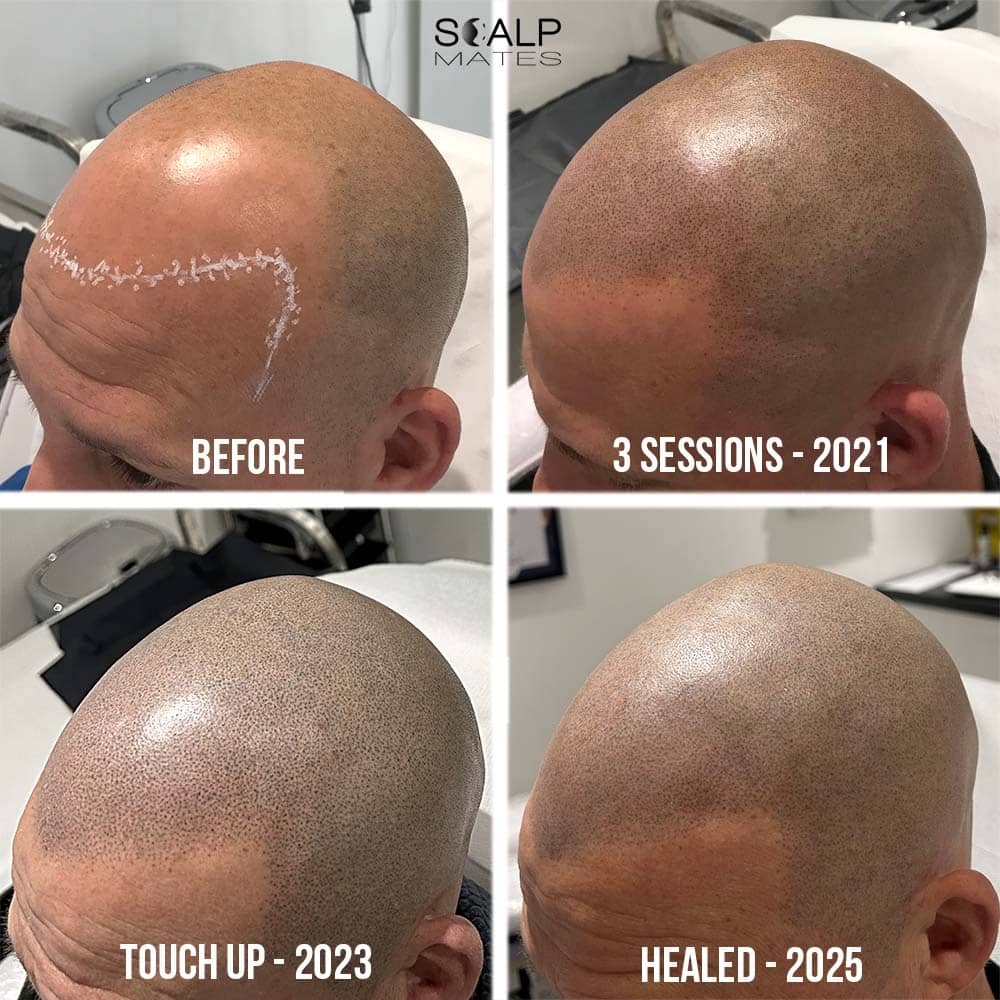
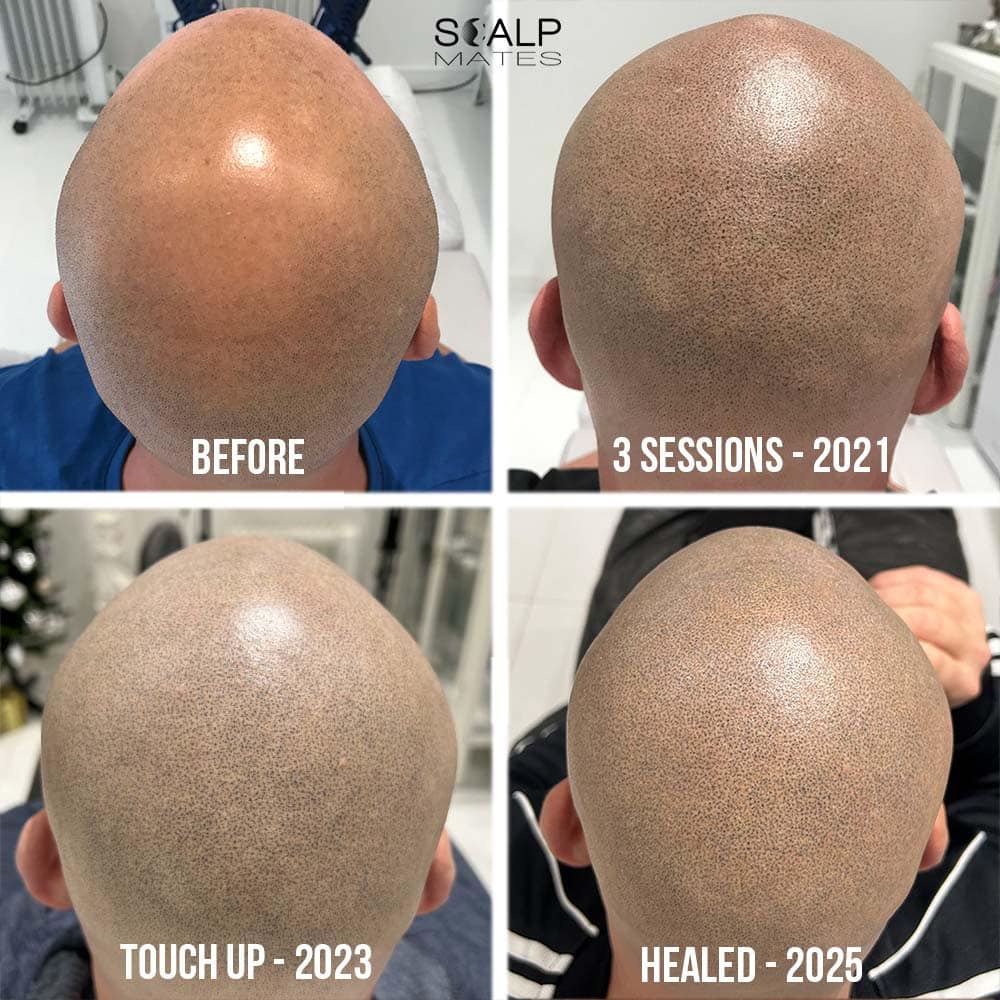
[Four-stage front-view grid showing BEFORE, 3 SESSIONS – 2021, TOUCH-UP – 2023 and HEALED – 2025.]
Why His SMP Looked Different in 2021 and 2023
This is something worth explaining because the photographs were taken at different times of the year.
In the original 2021 result, his skin was quite tanned.
That reduced the contrast between the pigmentation and his natural skin colour.
As a result, the SMP looked fairly subtle.
When he returned in December 2023, his summer tan had faded and his skin was noticeably lighter.
Naturally, the same pigment can appear more prominent against lighter skin.
But there was another reason for the difference.
He actually wanted his SMP to stand out a little more.
And this is something I’ve noticed with quite a few clients over the years.
Before their first treatment, they’re often very cautious.
“Keep it natural, Laur. Nothing too obvious.”
Then they get used to having their new hairline.
A year or two later, they’re a bit braver.
“Actually, Laur, can we make it a little stronger?”
I don’t mind that at all, as long as we keep things realistic.
The December 2023 Touch-Up
When he returned for his first maintenance appointment, he wanted a few adjustments.
We refreshed the pigmentation, made the overall result slightly darker and added a little more definition to the hairline.
He also wanted the temple areas built up slightly to frame the front better.
The idea was to make the result more noticeable without turning it into a sharp, aggressive hairline.
The photograph from December 2023 looks quite strong.
But there’s an important reason for that.
It was taken immediately after the touch-up.
Fresh SMP normally appears darker and more defined before the skin heals and the excess surface pigment clears away.
That freshly treated appearance isn’t the final healed colour.
And you can see the difference when comparing it with the December 2025 photographs.
By then, the pigmentation had settled into a much softer grey.
💡 What Happens to SMP Dots After Several Years?
Scalp micropigmentation works by placing thousands of tiny pigment impressions into the upper layers of the skin. The aim is to imitate the appearance of closely shaved hair follicles. But your skin isn’t a piece of paper. It changes, heals and renews itself over time.
As the years pass, the pigment can gradually become lighter, and some impressions may lose a little of their original sharpness. You might notice three things:
- The overall result becomes softer or lighter.
- Some areas fade faster than others.
- Individual pigment impressions can look slightly less defined.
This doesn’t automatically mean the SMP has gone wrong. It’s part of how long-term pigmentation can age. In this client’s case, the result was still looking very good in December 2025. The colour had remained a natural-looking grey, and the hairline was still clearly visible. However, some of the texture had softened, and there were a few lighter patches. That’s what we wanted to improve with his next maintenance appointment.
The Crown After Four Years: Did It Still Look Natural?
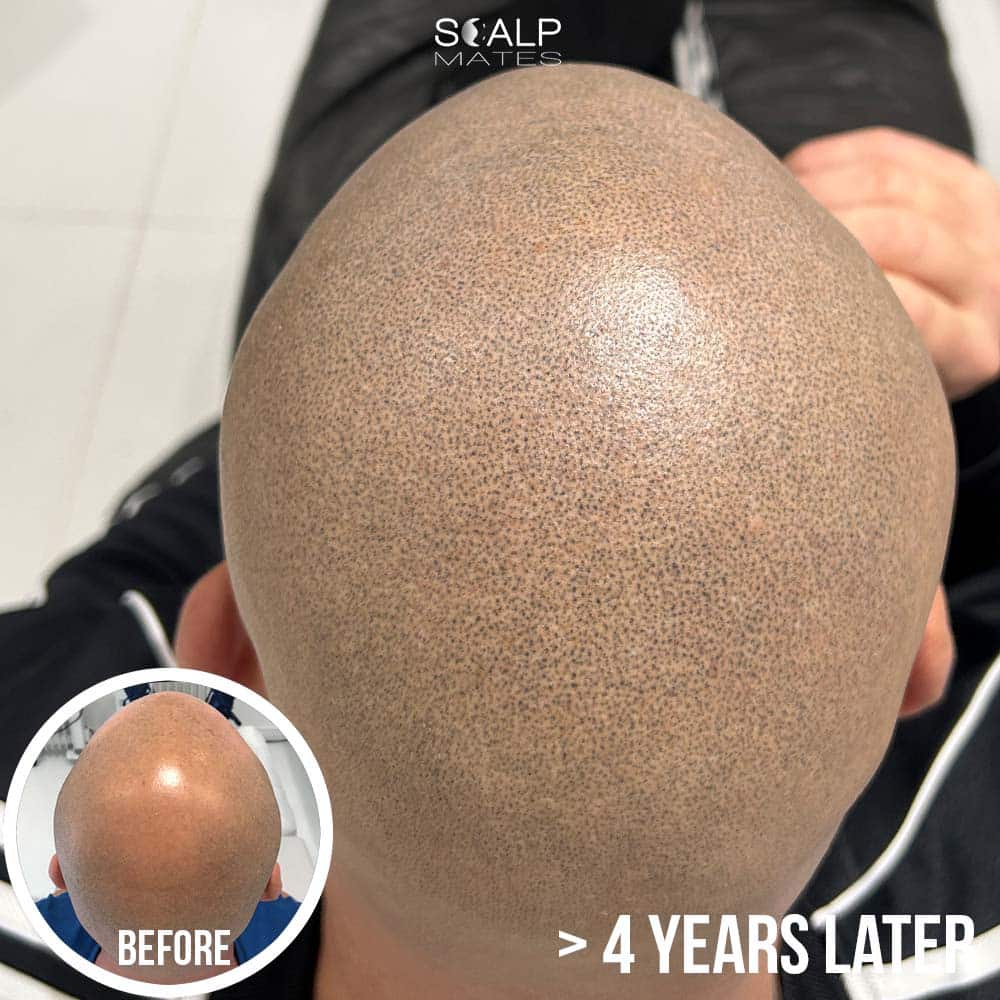
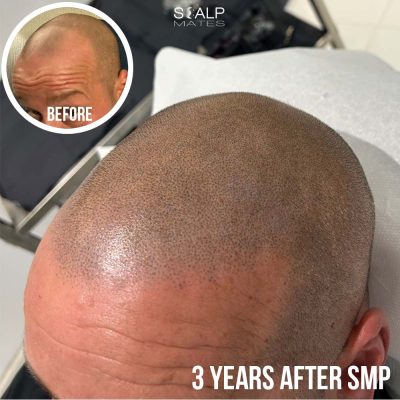
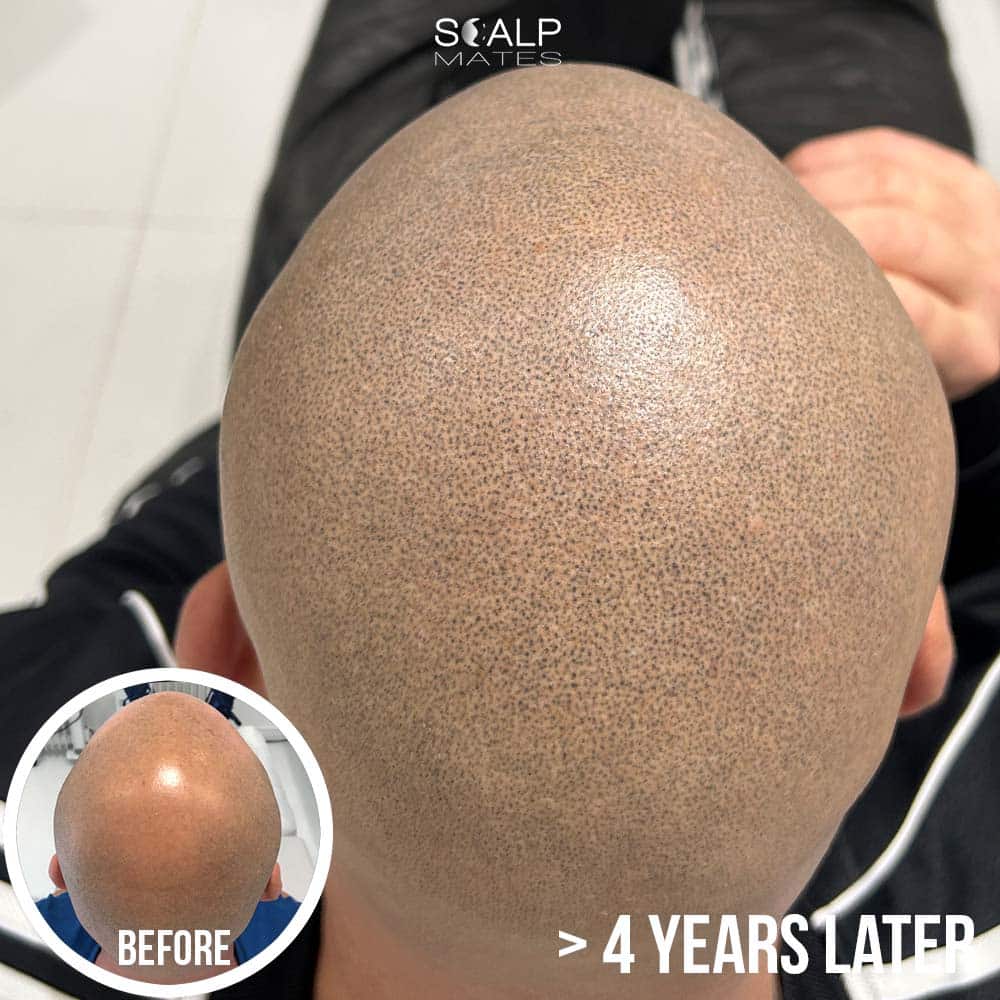
[More than 4 years after the original SMP treatment, crown photographed before the December 2025 touch-up.]
I think the crown photographs are particularly useful.
When someone has extensive male pattern baldness, the crown can be one of the trickiest areas to blend naturally.
You have to consider the existing hair around the back and sides, the direction of the natural growth and how closely the client shaves.
In this case, he maintained his head with a foil shaver, which helped keep the natural hair short enough to blend with the pigmentation.
Looking at the 2025 crown photographs, you can see that the SMP was still giving the appearance of shaved hair follicles across the previously bald area.
The pigmentation had softened, but there wasn’t an obvious solid patch or strange colour change.
The individual impressions were still visible, although not as sharply defined as they had been after the earlier sessions.
And that’s exactly the kind of long-term result I like to see.
Not necessarily as dark as day one, but still looking like it belongs on the client’s head.
December 2025: Why Have Another Touch-Up if the SMP Still Looks Good?
This gentleman is one of those clients who likes to stay on top of his maintenance.
He doesn’t wait until the pigmentation has faded so much that he’s unhappy with it.
He’d rather come back a little earlier and give everything a small refresh.
And I can understand that.
Some people wait until they feel the result needs a noticeable improvement.
Others prefer keeping it consistently fresh.
Neither approach is necessarily wrong.
What Did We Actually Do During the 2025 Touch-Up?
The aim wasn’t to make the SMP significantly darker.
He was already happy with the colour.
Instead, I wanted to rebuild some of the texture that had softened over the previous two years.
That meant adding fresh, small pigment impressions across the top, concentrating on areas where the older dots had become lighter or less defined.
It was a very light pass compared with the original treatment.
The appointment took no more than two hours.
We weren’t rebuilding a hairline from scratch or covering a completely bald scalp again.
We were simply refreshing an existing result.
Think of it a bit like maintaining something you already enjoy rather than starting all over again.
In fact, he was so comfortable with the whole process by this point that coming back felt more like visiting for a fresh trim.
That’s quite a change from how some people feel before their very first SMP appointment!
How Often Does Scalp Micropigmentation Need a Touch-Up?
This is one of the most common questions people ask.
And the answer is that there isn’t one fixed schedule for everyone.
Some people prefer refreshing their SMP every couple of years.
Others are happy leaving it longer, especially if they prefer a softer appearance (or if they had long-hair density SMP blended into existing hair).
How quickly the pigmentation changes can depend on several things, including skin characteristics, sun exposure, shaving habits, the original treatment and personal preferences.
This client had his initial treatment in summer 2021, followed by maintenance in December 2023 and December 2025.
So his touch-ups were roughly two years apart.
But that was his preference, not a rule that everyone must follow.
Does Travelling and Sun Exposure Affect SMP?
This gentleman enjoys travelling, although he mainly worked indoors and didn’t report excessive sun exposure.
Sunlight is worth considering because ultraviolet exposure can contribute to pigment fading over time.
I always recommend protecting the scalp from strong sunlight, particularly once the treatment has healed.
A suitable SPF or a hat can help reduce unnecessary exposure.
Of course, you can still enjoy your holidays.
Just don’t forget that a shaved scalp is exposed to the sun, whether you’ve had SMP or not.
His SMP Treatment Experience
| Treatment detail | Client experience |
|---|---|
| Initial treatment | July–August 2021 |
| Initial sessions | 3 |
| Pain across the crown | 3/10 |
| Pain around the hairline | 4/10 |
| Skin characteristics | Balanced, not particularly oily or dry |
| Client’s mood | Relaxed and comfortable |
| Separate consultation | Not required |
| Hairline preference | Natural, slightly V-shaped |
| Shaving method | Foil shaver |
| First maintenance | December 2023 |
| Second maintenance | December 2025 |
| December 2025 appointment | Light refresh across the top, up to 2 hours |
He found the original treatment manageable, with discomfort generally around 3 out of 10 across the crown and slightly higher around the hairline.
By the time he returned for maintenance, he was very familiar with the process.
And because the later appointments involved less work than the original treatment, they were considerably shorter.
The Part of This Story That Matters More Than the Hairline
There’s another reason I remember this client.
About a year after his initial treatment, he got married.
He’d wanted to improve his appearance and feel more confident, and SMP had become part of that journey.
After his wedding, he sent me some photographs and a message that I still remember:
“You did your part for me on my big day and I really appreciate it.”
That’s one of those messages that makes the job worthwhile.
I won’t share his wedding photographs because I’d rather respect his privacy.
But I think the message says enough.
Of course, scalp micropigmentation doesn’t magically change your life.
You’re still the same person afterwards.
But if something about your appearance has been bothering you for years, making an improvement can sometimes give you that little extra confidence.
And for him, that mattered on one of the biggest days of his life.
How Much Did His SMP and Touch-Ups Cost?
Let’s talk about the money, because I think it’s important to understand both the initial treatment and the possible maintenance costs.
For an equivalent treatment at my 2026 prices, this is what the breakdown would look like.
| Treatment | Equivalent 2026 price |
|---|---|
| Session 1 – Initial scalp coverage | £300 |
| Session 2 – Additional density | £300 |
| Session 3 – Hairline and blending refinements | £300 |
| Initial three-session treatment | £900 |
| December 2023 maintenance touch-up | £200 |
| December 2025 maintenance touch-up | £200 |
| Total across approximately 4½ years | £1,300 |
These are equivalent 2026 prices, not necessarily the amounts paid at the time.
And the maintenance appointments were priced according to the amount of work required.
They were much shorter than the original sessions because the existing pigmentation was still in good condition.
A touch-up isn’t always the same price, and it isn’t automatically needed every two years.
Some clients need more work, some need less, and some are perfectly happy leaving their healed SMP alone for longer.
I prefer assessing the actual condition of the pigmentation rather than charging everyone for a full treatment again.
For this gentleman, the two maintenance appointments would cost £200 each at my current rates.
That brings the equivalent total to £1,300 over approximately four and a half years.
I think that’s useful information for anyone considering SMP and wondering about the longer-term cost.
Common Questions About SMP Fading and Colour Changes
Does SMP always fade to grey?
A soft grey appearance is generally what I aim for with shaved-head scalp micropigmentation.
However, the exact healed colour depends on the pigment, technique, skin and other factors.
It isn’t possible to guarantee that every treatment will age identically.
Can SMP turn blue or green after several years?
Yes, unwanted colour changes can happen, particularly with unsuitable pigments or poor application techniques.
But they can be avoidable if the treatment is done correctly, using the right size needle, the right pigment shade, right depth and technique.
This client’s treatment showed no obvious blue or green discolouration in the December 2025 photographs, more than four years after his original sessions.
Why does fresh SMP sometimes look so dark?
Fresh pigmentation can look stronger because of the newly deposited pigment, temporary skin reaction and pigment remaining at the surface.
As the skin heals, the appearance normally softens.
That’s why I always encourage people to look at healed results rather than judging SMP entirely from photographs taken immediately after treatment.
Do SMP dots spread or become blurry?
Individual pigment impressions can soften and become less sharply defined over time.
How much this happens depends on several factors, including the original application and the way the pigment ages in the skin.
In this case, there was some softening after four years, but the overall result still looked natural.
The December 2025 maintenance appointment was mainly about restoring some of that fine texture.
Will I need an SMP touch-up every two years?
Not necessarily.
This client chose maintenance appointments approximately every two years because he preferred keeping the result fresh.
Other clients may wait longer.
The best approach is to assess how your pigmentation has aged and whether you’re still happy with its appearance.
Does SMP look different when you have a tan?
It certainly can.
When the surrounding skin becomes darker, the contrast between the skin and pigmentation may be reduced.
This was noticeable in the client’s 2021 photographs, when he had more of a tan.
By December 2023, his skin was lighter, which made the fresh pigmentation stand out more.
That’s another reason why photographs taken under different conditions shouldn’t be treated as perfectly controlled comparisons.
Thinking About SMP but Worried About How It Will Age?
If you’ve been looking into scalp micropigmentation but you’re worried about it turning blue, green or looking unnatural after a few years, I completely understand.
It’s your head, after all.
You want something that looks good now, but you also want to know what you’re getting into long-term.
That’s why I think real healed photographs are so important.
Fresh results are useful, but they don’t tell the whole story.
This gentleman’s case shows how one properly planned treatment aged over more than four years, including natural fading, some softening of the pigment impressions and two relatively small maintenance appointments.
And while nobody can promise that every SMP result will age exactly the same way, I hope these photographs give you a better idea of what a realistic long-term result can look like (you can also view more real client results and case studies).
If you’re considering SMP in Birmingham, Coventry or anywhere else in the UK, feel free to send me a few photographs on WhatsApp.
I’ll have a look at your hair loss, explain what I think would work and give you an estimated price.
No hard sales, no chasing.
Just a straightforward chat about your options.
Laur
Laurentiu Bradea
ScalpMates Birmingham
About these results: Initial SMP treatment took place in July–August 2021, followed by maintenance in December 2023 and December 2025. All photographs labelled as healed in December 2025 were taken before that month’s touch-up. The December 2023 photographs show freshly treated SMP, which normally appears darker before healing. Prices are equivalent 2026 rates. Individual pigment fading, colour changes and maintenance needs vary.