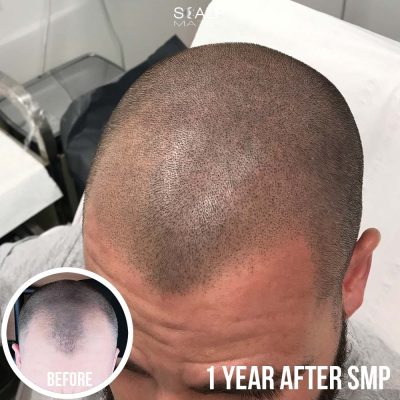
Explore Similar Hair Loss Transformations
Early 20s Scalp Micropigmentation: 2 Year Healed Result & Session Progression | Scalp Mates Birmingham
2 Years Healed Scalp Micropigmentation Result
2-Year Long-Term Review: Early 20s Hair Loss Transformation Without Touch-Ups
Facing aggressive hairline recession and crown thinning in your early 20s can feel overwhelming. Many young men struggle with early-stage androgenetic alopecia, cycling through temporary concealers or topical treatments before seeking a permanent cosmetic solution. A crucial concern for younger clients is how treatment evolves over time: Will the micro-dots blur, fade unevenly, or require constant maintenance every few months?
This case study documents a complete 2-year long-term evaluation for a client who started his scalp micropigmentation journey in his early 20s. We captured every milestone—from his initial digital hairline mockup and step-by-step 3-session build, to his 1-month healed client selfie, and ultimately his 2-year healed review photo. Taken prior to any refresher work, the photos prove that his treatment remained so crisp, defined, and stable that no touch-up was required at the 24-month mark.
—
Client Profile & Treatment Strategy
- Client Age & Demographic: Early 20s Male
- Hair Loss Classification: Norwood 4 Atypical (Frontal Recession & Diffuse Top Scalp Thinning)
- Treatment Protocol: Digital Hairline Mapping + 3 Progressive Pigment Layering Sessions
- Healed Benchmarks Tracked: 1-Month Post-Treatment Selfie & 2-Year Annual Review
- 24-Month Status: Excellent Pigment Retention — Zero Touch-Up Work Needed
—
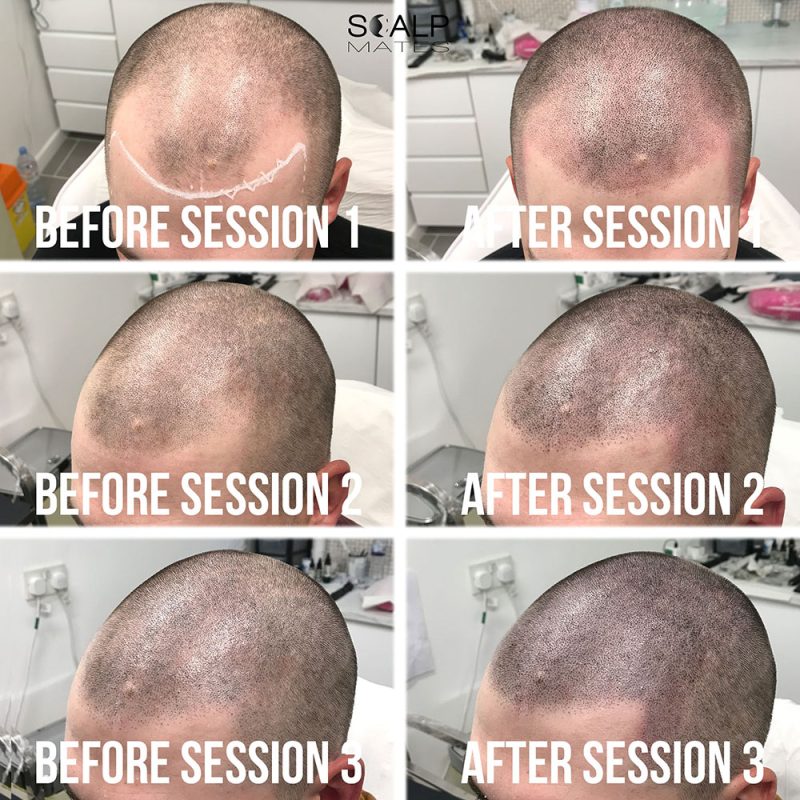
Session-by-Session Build: From Digital Mockup to Healed Reality
A natural hairline tattoo for men requires careful planning to ensure the front edge matches facial symmetry and ages naturally. Here is how his 3-session progression unfolded:
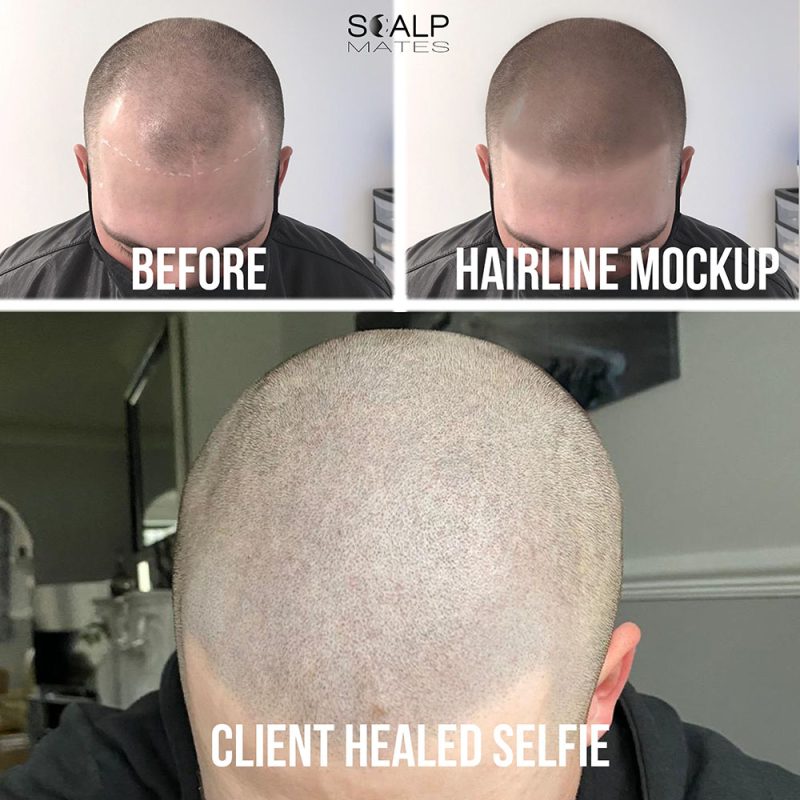
Step 1: Digital Hairline Mockup & Mapping
Before making a single impression, we drew a soft, broken hairline guide across his forehead and generated a digital mockup. This allowed the client to visualize his future profile, verify the height of his temple points, and confirm a natural framing that suited his young features.
Session 1: Soft Base Layer
Using a conservative pigment shade, Session 1 established the spatial boundary of his new hairline and scattered a light foundation layer across his thinned top scalp. Minor post-procedure redness resolved within 24 to 48 hours.
Session 2: Density & Depth Layering
Fourteen days later, Session 2 focused on creating structural density. We placed micro-impressions between the initial base dots, filling in the thinned crown and strengthening the frontal hairline transition zone.
Session 3: Final Detail & Edge Feathering
During the final appointment, we fine-tuned the entire scalp, softening the frontal edge with broken micro-dots so the treatment appeared completely organic even under direct sunlight.
—
Evaluating the 1-Month Selfie vs. 2-Year Healed Proof
Reviewing online search trends for a hair tattoo for bald head or general hair tattooing for hair loss reveals that prospective clients want real-world evidence. Fresh photos show sharp detail, but healed photos reveal true artistry.
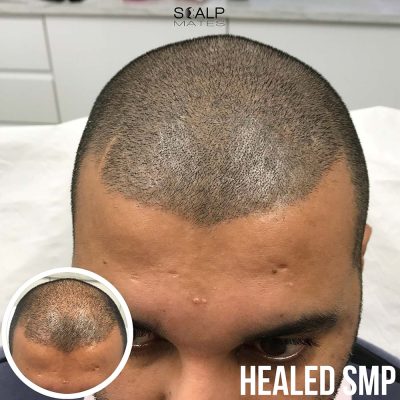
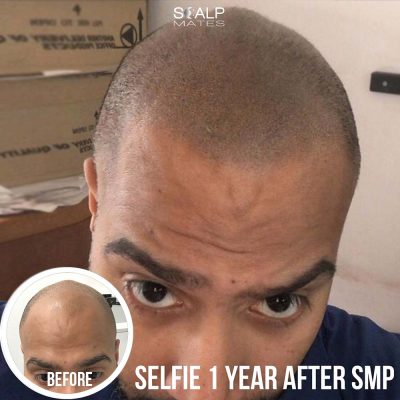
- 1-Month Healed Selfie: Sent in directly by the client roughly 30 days after Session 3, this photo shows the pigment after the top layer of skin naturally exfoliated. The impressions settled into a soft, realistic shade of shaved hair roots.
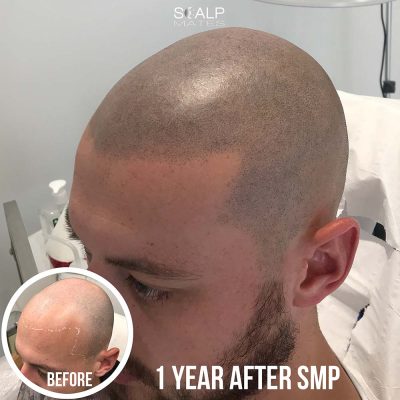
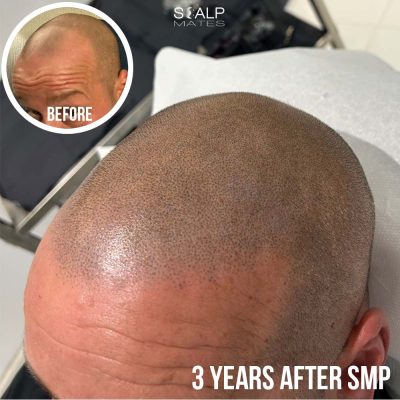
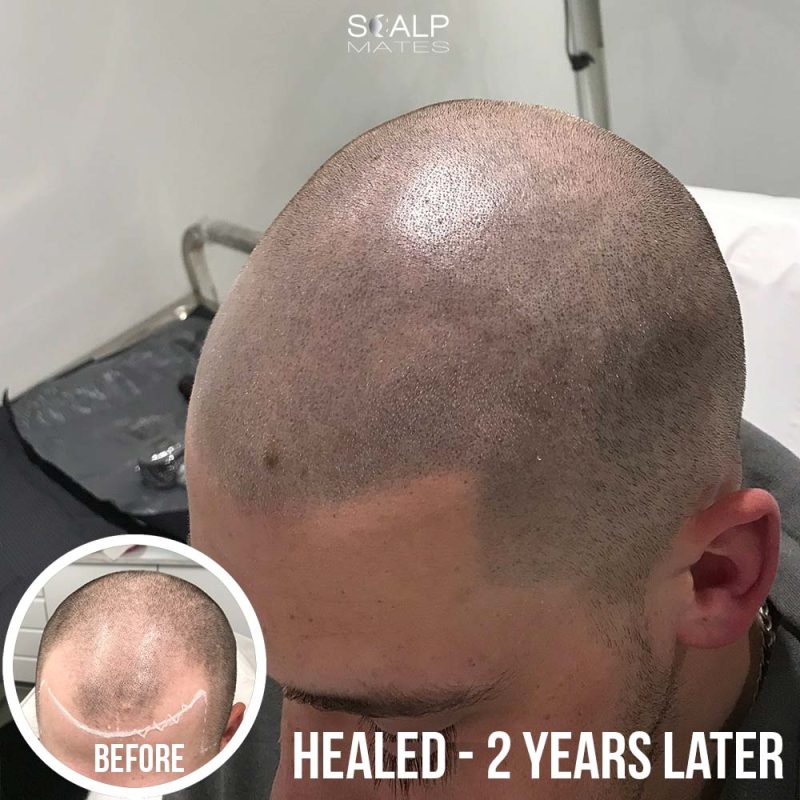
- 2-Year Healed Assessment: Taken during a routine 24-month review, this close-up profile demonstrates flawless longevity. The micro-dots held their distinct size without expanding into one another, maintaining a clean bald head tattoo hair appearance that completely restored his confidence throughout his mid-20s.
Clinical Checkup Assessment: At the 2-year inspection under clinical lighting, the pigment density across his frontal zone and vertex retained approximately 85% of its original post-session depth. Because the fading was minimal and perfectly uniform, no touch-up session was performed, extending his maintenance-free timeline further into the future.
—
Why Quality SMP Lasts 2–5 Years Without Refreshers
When considering mens scalp tattoo options or general tattooing for baldness, fading timelines depend on practitioner technique and skin metabolism. High-grade scalp micropigmentation utilizes organic, carbon-based pigments deposited precisely into the upper papillary dermis.
By avoiding excessive depth (which causes pigment bleeding) and avoiding overly shallow placement (which causes rapid fading), a well-executed treatment routinely lasts 2 to 5 years before requiring a quick 1-2 hour refresher session. For a young client in his early 20s, this offers a hassle-free, cost-effective hair loss solution that fits an active lifestyle.
—
Frequently Asked Questions About Long-Term SMP
How long does a hair tattoo on a bald head last before needing a touch-up?
While individual skin oiliness and sun exposure play a role, most clients do not need a touch-up for 2 to 4 years. As demonstrated in this case study, many clients reach the 2-year mark with almost full density and zero need for additional work.
But bear in mind that every skin is different, some clients come a bit earlier and may want or need a touch up before the 2 yr mark.
Does SMP look natural on young men in their early 20s?
Yes. The key for younger men is avoiding an overly straight or unnaturally sharp “line-up.” By designing a soft, feathered hairline with natural broken edges, the result looks like a natural, intentional buzz cut rather than a cosmetic procedure.
What should I do to make my healed SMP last as long as possible?
To maximize pigment longevity over 2+ years, apply a daily matte moisturizer with SPF 30 or higher when spending extended time in direct sunlight, and avoid harsh chemical peels directly on the treated scalp area.
2 Year Healed SMP Results – Why Quality SMP Lasts 2–5 Years Without Refreshers