SMP for Thinning Hair: The Truth About Those Incredible Before & After Photos
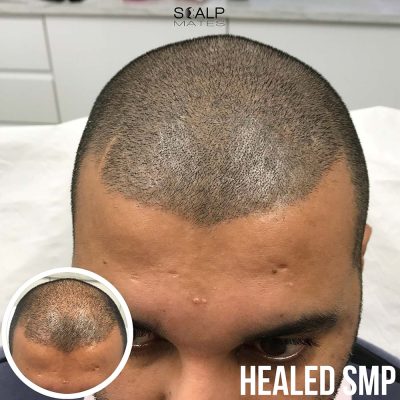
Ever seen a hair tattoo make someone’s thinning hair look unbelievably thick overnight? Well, there’s something you should know about those photos. Fresh scalp micropigmentation can look fantastic, but some of that dramatic darkness is temporary. Let me show you what density SMP actually looks like once it’s healed, washed and settled.
Crown Density SMP: Progression & Results
This gentleman came to my Birmingham studio in July 2021. He was in his late 30s and had been losing hair for years, particularly around the crown.
He still had a reasonable amount of hair, but the thinning had reached the point where his scalp was becoming quite visible. His hairline was also receding, although he’d been keeping his hair longer at the front to disguise it.
He wasn’t looking for a completely new hairstyle. He wanted to keep the hair he had and make the thinning areas less noticeable using specialised density SMP processes.
And that’s exactly what we worked towards.
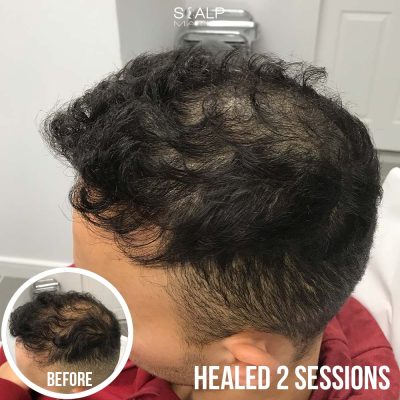
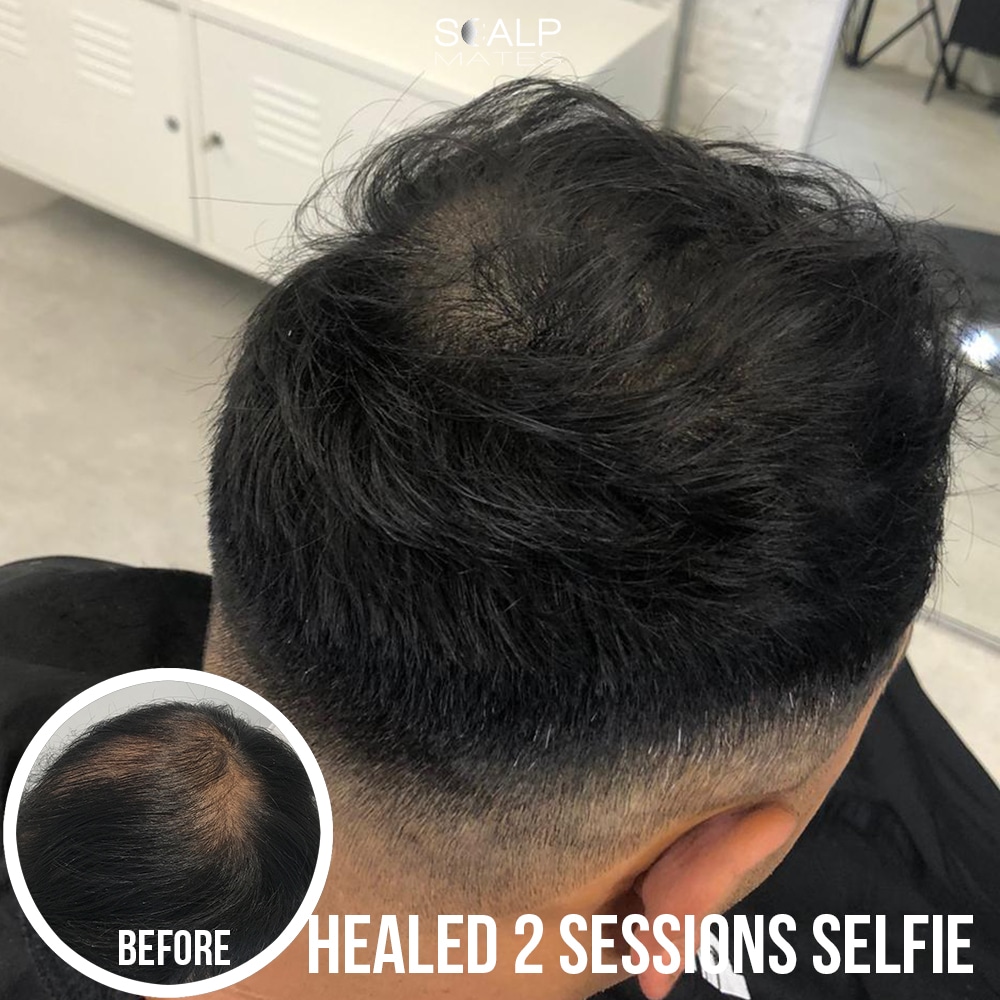
The photographs show his real healed results, including a selfie he proudly sent me from the barbershop a few weeks after his second session.
No freshly applied pigment pretending to be a full head of thick hair!
Quick Look at This Crown Density SMP Treatment
| Treatment information | Client details |
|---|---|
| Hair loss | Thinning crown and slightly receding hairline |
| Age | Late 30s |
| Hair type | Long, dark hair |
| Desired result | Reduce visible scalp without shaving his head |
| Treatment | SMP density for thinning hair |
| Sessions completed | 2 |
| Treatment date | July 2021 |
| Client location | Birmingham |
| Equivalent cost in 2026 | £500 (£250 per session) |
| SMP practitioner | Laurentiu Bradea (Laur), ScalpMates Birmingham |
He Still Had Hair. He Just Wanted Less Scalp Showing Through.
When he first came to see me, the main concern was his thinning crown.
He’d been losing hair gradually for several years, and although there was still hair growing through the area, it had become thin enough for the scalp to show quite clearly.
His hairline had also started receding, but he managed to disguise that by keeping the front slightly longer.
The crown was a different story.
It’s a difficult area to hide, especially under bright lighting or when someone is looking down at the top of your head.
And here’s where scalp micropigmentation can sometimes help.
Instead of creating a new shaved hairline, as I do for my bald clients (explore our Shaved Head SMP Complete Guide), I use tiny pigment impressions to reduce the contrast between the hair and the skin underneath.
Think of it this way.
If you’ve got dark hair sitting over a light scalp, every little gap between the hairs becomes more noticeable.
By darkening some of that visible scalp with carefully placed pigment, we can make those gaps stand out less.
It doesn’t give you more actual hair, but it can create the appearance of better coverage.
And for someone who isn’t ready to shave his head, that can make a worthwhile difference.
💡 Practitioner Insight: Camouflaging Visible Scalp
For comprehensive information on how density treatments work, read our dedicated Density SMP Process Guide.
The Truth About Density SMP Before & After Photos
Now, I want to explain something that I think every person considering SMP for thinning hair should understand.
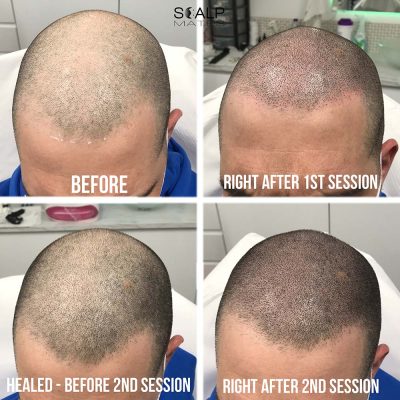
Fresh density SMP can look much thicker than the final healed result.
Immediately after treatment, there’s still excess pigment on the skin and around the existing hair.
This can temporarily darken the whole area, making the scalp appear almost completely covered.
If I took a photograph at that moment, you’d probably think I’d performed some sort of miracle.
Unfortunately, some of that dramatic darkness disappears after the first few washes.
The excess pigment is removed, the skin settles and the actual implanted pigment becomes more visible in its healed form.
That’s the result that matters.
It’s also why I don’t particularly bother showing clients freshly treated density SMP as the final result.
I’d rather wait until the scalp has healed and the hair has been washed several times.
Here’s What One Session Looked Like Once Healed
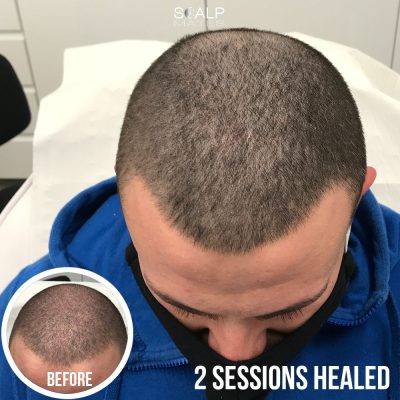
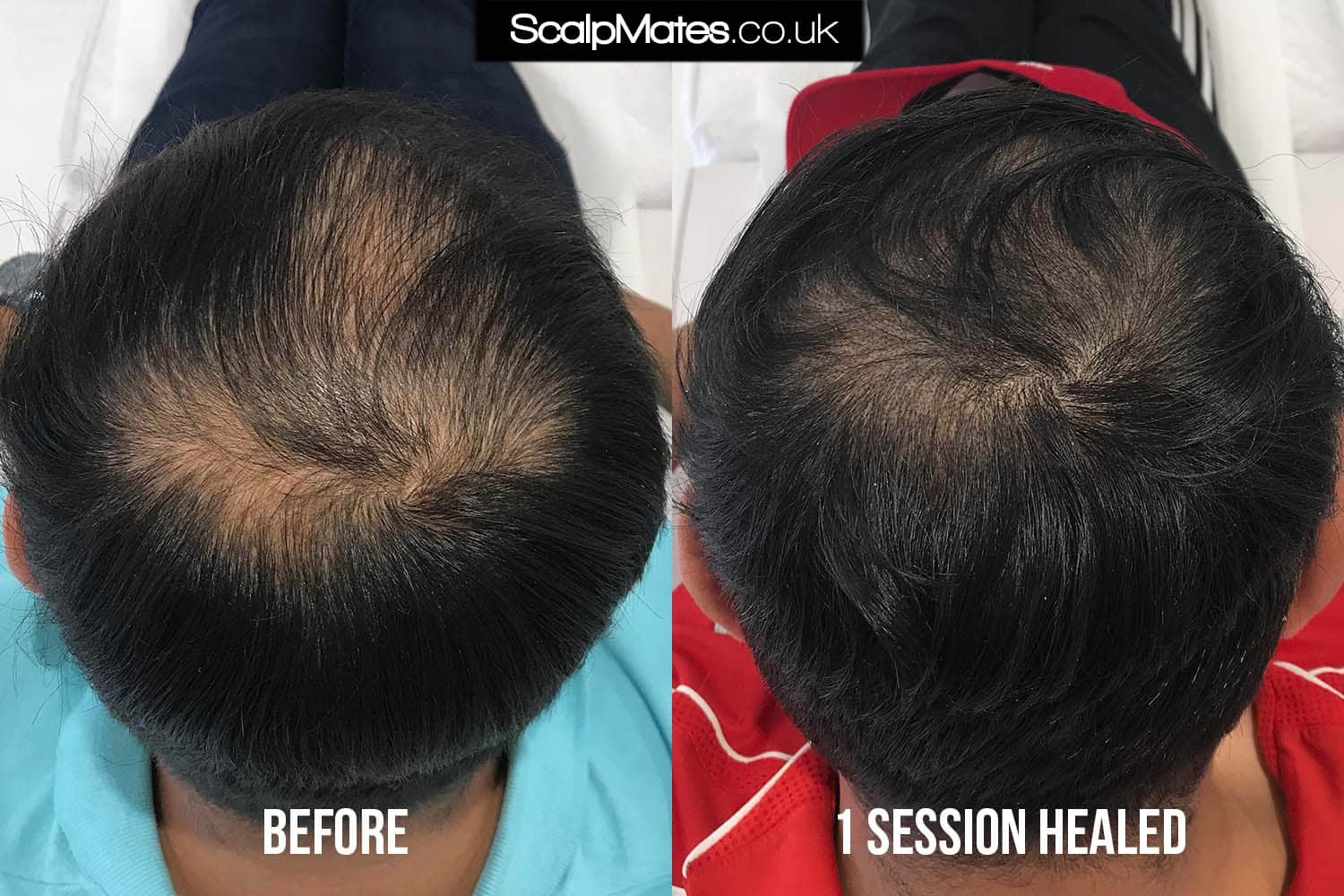
The first healed comparison was taken a few weeks after his initial treatment.
By that point, the excess pigment had been washed away and the remaining pigment had settled into the skin.
You can still see the thinning area.
And that’s important.
I wasn’t trying to create the illusion that he’d suddenly grown a thick head of hair.
The goal was simply to make the scalp less obvious between the existing hairs.
It’s a more subtle improvement than the dramatic photographs you sometimes see online, but it’s also a more realistic example of what density SMP can achieve.
Why SMP Works Better for Some Thinning Crowns Than Others
This is probably the most important thing to understand before booking a density treatment.
You need enough existing hair for the pigmentation to blend into.
If someone has diffuse thinning, where the hair is still reasonably evenly spread across the scalp but has become thinner overall, density SMP can work quite nicely.
There’s still hair everywhere, so the pigment helps reduce the contrast between the hair and scalp.
But imagine someone with a completely bald crown surrounded by longer, thick hair.
If I simply tattoo that bald patch dark, what happens?
You’d have a flat, dark-looking area in the middle of the head, surrounded by real hair with volume and texture.
Not exactly the result we’re after!
SMP doesn’t create physical hair, so it cannot replace the texture or movement of missing hair.
For someone with a large bald patch who wants to keep the surrounding hair long, I may actually advise against density SMP.
I’d rather turn down a treatment than create something that looks unnatural.
Why I Treated Beyond His Crown
In this gentleman’s case, I didn’t stop exactly where the crown was thinning.
I gradually feathered the pigmentation into the surrounding areas, working towards the front where his hair was also slightly thin.
There was a good reason for this.
Hair moves.
One day you might style it to the left, the next day to the right. The wind might have other plans altogether!
If I create a very dark patch only in the centre of the crown, it could become noticeable when the hair changes position.
By gradually reducing the pigment density towards the edges, I can create a softer transition.
The aim is to avoid any obvious line between the treated and untreated areas.
Choosing the Right Pigment: Dark Enough to Help, But Not Too Dark
With shaved-head SMP, I’m usually trying to imitate tiny, closely shaved hair follicles. For more details on our standard 3-session workflow, check out our 3-Session Shaved Process Guide.
With density SMP for longer hair, the goal is slightly different.
I want to reduce how much light scalp you can see through the hair.
For this client, I used a dark pigment shade to work with his naturally dark hair.
But that doesn’t mean simply colouring the whole scalp black.
I still need to create individual pigment impressions rather than a solid painted-looking patch.
Up close, the scalp should still have its natural texture and variation.
There’s also something else I always consider.
What Happens If He Decides to Shave His Head in Five Years?
This is a question I like to ask clients before starting density SMP.
What if your hair loss continues?
What if, a few years from now, you decide you’ve had enough of keeping your hair long and want to shave it all off?
If I’ve made the crown extremely dark, that could become a problem.
You might end up with a dark patch of pigmentation on top of an otherwise closely shaved head.
And correcting overly dark SMP isn’t always straightforward.
That’s why I try to find a sensible balance.
Enough pigment to improve the appearance of thinning hair today, but not so much that it creates an obvious problem if the client changes his hairstyle in the future.
Of course, nobody can predict exactly how someone’s hair loss will progress.
But it’s worth having that conversation before treatment, rather than afterwards.
Second Session: The Barber-Shop Selfie That Made My Day
After his first session had healed, he returned for a second appointment.
I added further density through the crown and blended the pigmentation into the surrounding thinning areas.
A few weeks later, he sent me a photograph taken at his barbershop.
He was clearly pleased with the improvement.
And I think the photograph tells the story quite well.
There’s still visible scalp through some of the hair, particularly where the crown naturally separates.
But compared with the original before photo, the contrast is reduced and the area appears more evenly covered.
This is what I want people to look for when comparing healed density SMP results.
Not a magically thick head of hair.
Just a genuine improvement that works with the hair you’ve already got.
His Friends Noticed Something Different. But Nobody Guessed It Was a Tattoo!
One of the more amusing parts of this treatment was hearing how people around him reacted.
A few close friends and family members noticed that his hair fuller and asked what he’d had done.
But nobody seemed to suspect scalp micropigmentation.
In fact, the idea of having his scalp tattooed didn’t even cross their minds.
He was a little surprised by that himself.
Rather than explaining the treatment, he gave them a few alternative explanations involving hair oils and other products.
I suppose that was easier than getting into a lengthy conversation about cosmetic tattoos!
There was also a personal reason behind it.
He wasn’t particularly concerned about the treatment from a religious point of view himself, but he knew some more traditional family members might have questions about whether SMP was halal or haram.
He simply preferred not to have that conversation.
And because nobody suspected a tattoo, he didn’t have to.
Is Scalp Micropigmentation Halal or Haram?
This is a question I sometimes get from Muslim clients.
There are Islamic scholarly opinions and fatwa rulings that distinguish certain forms of scalp micropigmentation from conventional decorative tattooing, with some permitting the procedure under particular conditions.
However, not all scholars agree, and the ruling may depend on the technique and circumstances.
If this is important to you, I’d recommend reading the relevant fatwa and speaking with a trusted Islamic scholar before deciding.
You can also ask me about how the treatment works, so you have the information needed to make your own decision.
What Was His Density SMP Treatment Like?
| Treatment experience | Client details |
|---|---|
| Pain rating | 4/10 |
| Most sensitive areas | Some mild-to-moderately sensitive spots |
| Treatment area | Crown, blended into surrounding thinning hair |
| Sessions completed | 2 |
| Return to work | The following day |
| Healed results available | After sessions 1 and 2 |
| Client’s reaction | Very pleased with the improvement |
| Friends and family | Noticed fuller-looking hair, but didn’t suspect SMP |
He was comfortable enough throughout both treatments.
There were a few more sensitive spots, but overall he rated the discomfort around 4 out of 10.
He was also able to return to work the following day.
One advantage of density SMP is that the existing hair can help disguise some of the temporary redness after treatment.
Of course, everyone’s scalp reacts differently, so I wouldn’t promise that there will be no visible signs immediately afterwards.
Does Density SMP Damage Your Existing Hair Follicles?
This is another question I get quite often.
And it’s understandable.
If you’re already losing your hair, the last thing you want is a treatment that could make things worse.
Scalp micropigmentation is designed to deposit pigment into the upper layers of the skin, rather than targeting the deeper hair roots.
When performed correctly, it’s not expected to damage the existing hair follicles.
However, like other procedures involving needles, SMP isn’t completely risk-free. Poor technique, infection or significant inflammation could potentially affect the skin and hair.
Can SMP Actually Stimulate Hair Growth?
I wouldn’t rely on it for that.
You may have heard about microneedling or dermarolling being used to encourage hair growth.
Although SMP also involves tiny needles entering the skin, it’s a different procedure with a different purpose.
There’s no good evidence that scalp micropigmentation itself regrows hair.
I don’t offer it as a hair-growth treatment, and I wouldn’t want anyone booking SMP expecting their hair to become physically thicker.
The improvement is cosmetic. We’re making the existing hair look fuller by reducing the visibility of the scalp underneath.
Is Density SMP Worth Considering Instead of a Hair Transplant?
For some people, absolutely.
But the two treatments do very different things.
A hair transplant moves actual hair follicles from one area of the scalp to another.
SMP doesn’t move or grow any hair. It creates the appearance of greater coverage by adding pigment to the skin.
Some people simply don’t want to go through surgery, recovery and the expense of a transplant.
Others have already had a transplant but still have visible thinning, or they may not have enough suitable donor hair for another procedure.
And some people just want to keep their existing hairstyle looking presentable for as long as possible.
Density SMP can sometimes be a useful option in those situations.
But it won’t stop hair loss from progressing.
If your hair continues thinning, the appearance of the treatment may change, and you might need further work or a different approach later.
That’s why I always assess the remaining hair and discuss the client’s longer-term plans before recommending treatment.
How Much Does SMP for a Thinning Crown Cost in Birmingham?
For an equivalent treatment at my current 2026 prices, this client’s two sessions would cost:
| Treatment | Price |
|---|---|
| First session: Crown coverage and initial blending | £250 |
| Second session: Additional density and refinement | £250 |
| Total treatment cost | £500 |
These are equivalent 2026 prices, not necessarily what he paid in July 2021.
Although his main concern was the crown, I also blended the pigmentation into the surrounding thinning areas to avoid creating an obvious dark patch.
The exact price depends on how much of the scalp needs treating and how much existing hair there is to work with.
Some clients may need more than two sessions, while others may not be suitable candidates for density SMP at all.
You can find more information in my scalp micropigmentation pricing guide.
A Few Questions About SMP for Thinning Hair
Can scalp micropigmentation make my hair look thicker without shaving it?
Yes, provided there’s enough existing hair for the pigment to blend into.
The treatment darkens selected areas of visible scalp, which can make the hair appear fuller.
It doesn’t increase the number of hairs or their physical thickness.
You can learn more in my guide to scalp micropigmentation for long hair in Birmingham.
Does SMP work better for diffuse thinning or a bald crown?
Generally, diffuse thinning gives us a better starting point because there’s still hair distributed across the area.
A completely bald crown surrounded by longer hair can be much harder to treat convincingly.
Suitability depends on the size of the thinning area, remaining hair density, hairstyle and future hair loss.
Why does density SMP look darker immediately after treatment?
Fresh treatment can leave excess pigment on the scalp and surrounding hair, temporarily making the area look much darker.
Once the hair has been washed and the skin has healed, the appearance becomes softer.
That’s why I prefer showing genuine healed results rather than relying on photographs taken immediately after the procedure.
Will people notice I’ve had density SMP?
Some people may notice that your hair appears fuller without understanding why.
That’s exactly what happened with this client.
His friends and family noticed an improvement, but nobody immediately suspected a hair tattoo.
Of course, this doesn’t guarantee the treatment will be undetectable for everyone.
What happens if I lose more hair after density SMP?
That’s something we need to consider before treatment.
As the natural hair becomes thinner, previously hidden pigmentation may become more visible.
If you’re likely to shave your head in the future, I need to take that into account when choosing the pigment shade and density.
The aim is to improve your appearance now without creating unnecessary problems later.
Thinking About Keeping Your Hair a Little Longer?
If your crown is thinning but you’re not quite ready to shave your head, density SMP might be worth looking into.
It won’t give you a thick head of hair overnight, and it certainly won’t stop hair loss.
But for the right person, it can reduce the amount of scalp showing through and help make the remaining hair look fuller.
And sometimes, that’s all someone really wants.
If you’d like to know whether it could work for you, feel free to send me a few clear photos on WhatsApp
I’ll have a look at your hair loss, explain what’s realistic and give you an estimated price.
And if I don’t think density SMP would look right, I’ll tell you that too.
You can also explore more real client results and case studies.
Laur
Laurentiu Bradea
ScalpMates Birmingham
About this case study: This client received density scalp micropigmentation in July 2021. The photographs show genuine healed results after the first and second sessions, including a later selfie taken at his barbershop. Prices shown reflect an equivalent treatment at 2026 rates. Density SMP is a cosmetic camouflage treatment and does not restore lost hair or prevent further hair loss. Individual results vary.