Can SMP Really Make Thinning Hair Look Thicker? Real Healed Results on Long Hair
Scalp micropigmentation for thinning hair – 3-session density treatment in Solihull, near Birmingham
Can scalp micropigmentation really make thinning hair look thicker, or does it just leave you with a dark, painted-looking scalp?
That’s a fair question, especially if you’re planning to keep your hair long.
This client in his early 30s came from Solihull with thinning hair across the top of his head, particularly around the crown and front hairline. He wanted to improve the appearance of his hair density without shaving his head or going through a hair transplant.
We completed three sessions of scalp micropigmentation (SMP), carefully blending tiny pigment impressions between his existing hair follicles.
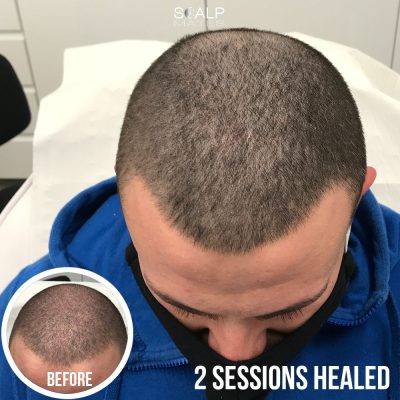
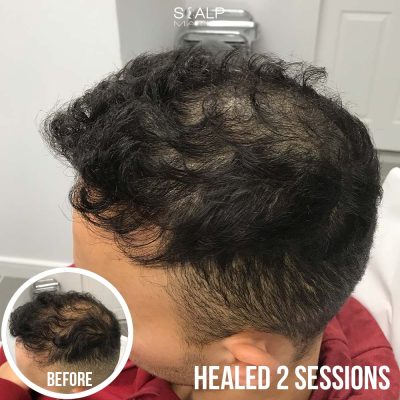
And the results I’m showing here are fully healed after two sessions, photographed around 3–4 weeks after his second treatment.
No fresh pigment making the scalp look temporarily darker. No clever tricks to make the hair appear thicker than it really is.
Just a realistic improvement in how much scalp shows through his existing hair.
Client Details – Solihull Hair Density SMP
| Client information | Details |
|---|---|
| Age | Early 30s |
| Location | Solihull, West Midlands |
| Treatment dates | February–March 2026 |
| Hair loss | Diffuse thinning across the top, crown and hairline corners |
| Hair type | Jet-black hair, kept at a shorter, manageable length |
| Skin tone | Light Asian skin tone |
| Desired result | Fuller-looking hair without shaving or having a transplant |
| Treatment | Scalp micropigmentation for hair density |
| Sessions completed | 3 |
| Results photographed | 2 sessions fully healed |
| Equivalent 2026 price | £300 per session – £900 total |
| SMP practitioner | Laurentiu Bradea (Laur), ScalpMates Birmingham |
Can Scalp Micropigmentation Make Thin Hair Look Thicker?
Yes, it can. But there’s something important you need to understand before considering density SMP.
We’re not actually making your hair thicker. We’re making the scalp underneath less noticeable.
When someone has diffuse thinning, the lighter scalp starts showing through the darker hair. That contrast makes the hair look thinner than it might otherwise appear.
By placing thousands of tiny pigment impressions between the existing hair follicles, we can reduce that contrast.
The hair itself stays exactly the same. We’re simply creating the appearance of additional hair roots underneath it.
This tends to work particularly well for people who still have a reasonable amount of hair covering the thinning areas.
And that’s what made this client a good candidate.
He had plenty of his own hair remaining, but the density had reduced enough for the scalp to become quite visible, particularly under direct lighting.
My job was to make those thinner areas less noticeable while keeping everything looking natural.
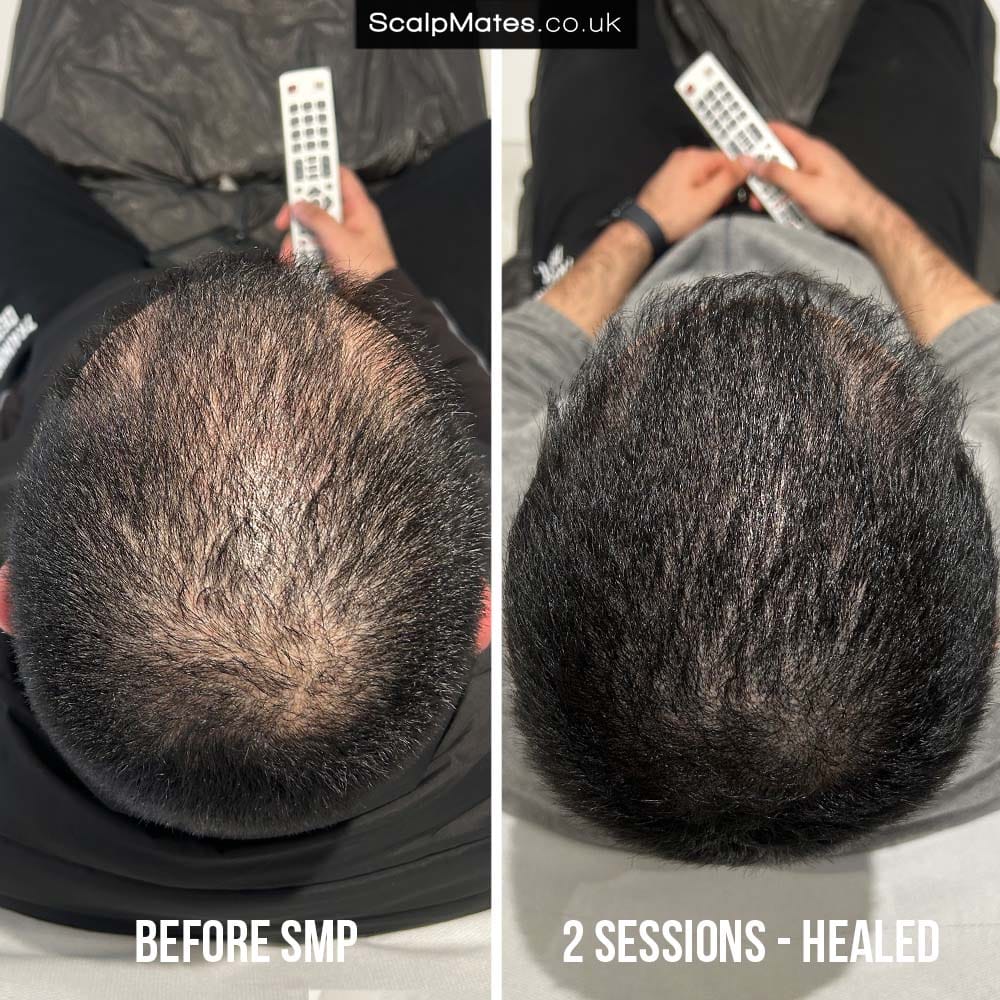
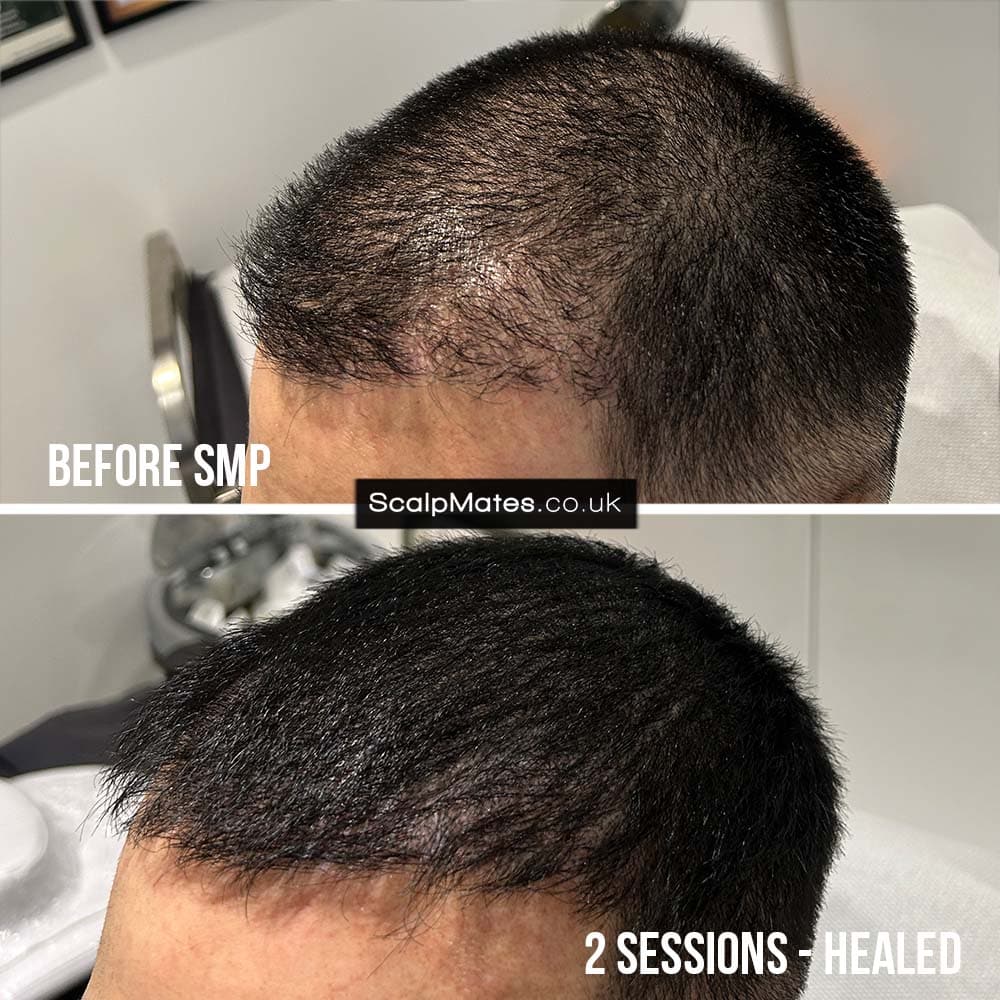
Before SMP compared with two sessions fully healed. Notice how the scalp is less visible through his existing hair, particularly across the top and crown. This photo was taken approximately 3–4 weeks after his second session.
Why I Told Him His Hair Would Still Look Thin in Certain Lighting
Before starting, I made something very clear.
His hair wasn’t suddenly going to look like he’d grown another 20,000 hairs.
He would still have some visible scalp, especially under strong overhead lighting or when the hair separates.
And that’s perfectly normal.
In fact, I would be quite concerned if someone promised him completely thick-looking hair from every angle.
Density SMP works by reducing the visibility of the scalp, not replacing the actual volume of missing hair.
The good thing about this client was that he’d already done his research.
He understood what SMP could achieve and wasn’t expecting a miracle.
He’d considered his options and preferred this route rather than going through a hair transplant.
He initially contacted me through WhatsApp, sent over some photographs of his thinning areas and asked a few questions.
After discussing what was realistically possible, he booked his first session.
Why I Prefer Keeping the Pigment Dots Small, Even With Long Hair
Here’s something I think is worth explaining, especially if you’re comparing SMP results from different clinics.
Some people assume that because the client has long hair covering the scalp, we can simply use much darker pigment and pack everything in as heavily as possible.
Technically, we can go a little darker with density SMP than we would on a completely shaved head.
And that’s exactly what I did here.
His jet-black hair allowed me to use a slightly darker shade to help reduce the contrast.
But I still kept the pigment impressions very small, roughly matching the appearance of natural hair follicles.
Why?
Because I don’t want to ruin someone’s scalp just to make their hair look thicker today.
Imagine this client loses more hair over the next five or ten years and eventually decides to shave his head.
If I’d filled his scalp with oversized dots or heavy, solid patches of pigment, those areas could become very obvious once the hair is gone.
Correcting that sort of work can be difficult and may require laser removal.
That’s why I prefer to keep the individual impressions small and reasonably natural, even when working underneath longer hair.
We can adjust the density and shade, but I don’t want the scalp looking painted.
And if someone comes close enough to inspect it, I’d still like those impressions to resemble tiny hair roots rather than a solid block of colour.
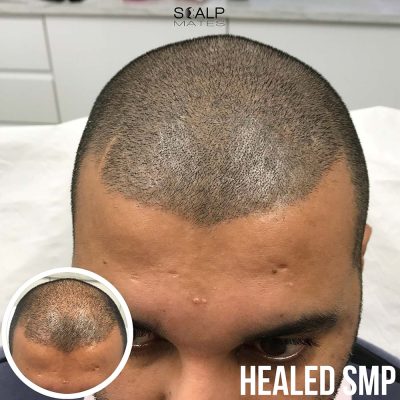
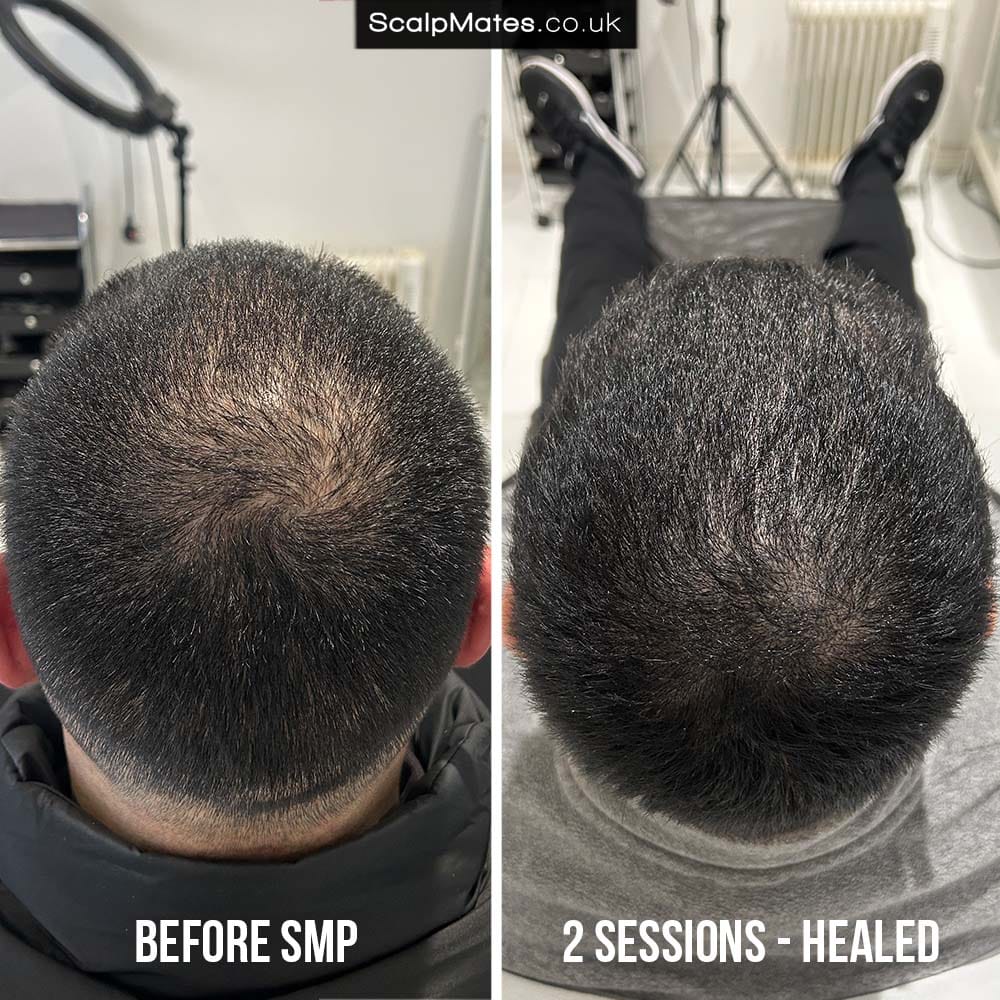
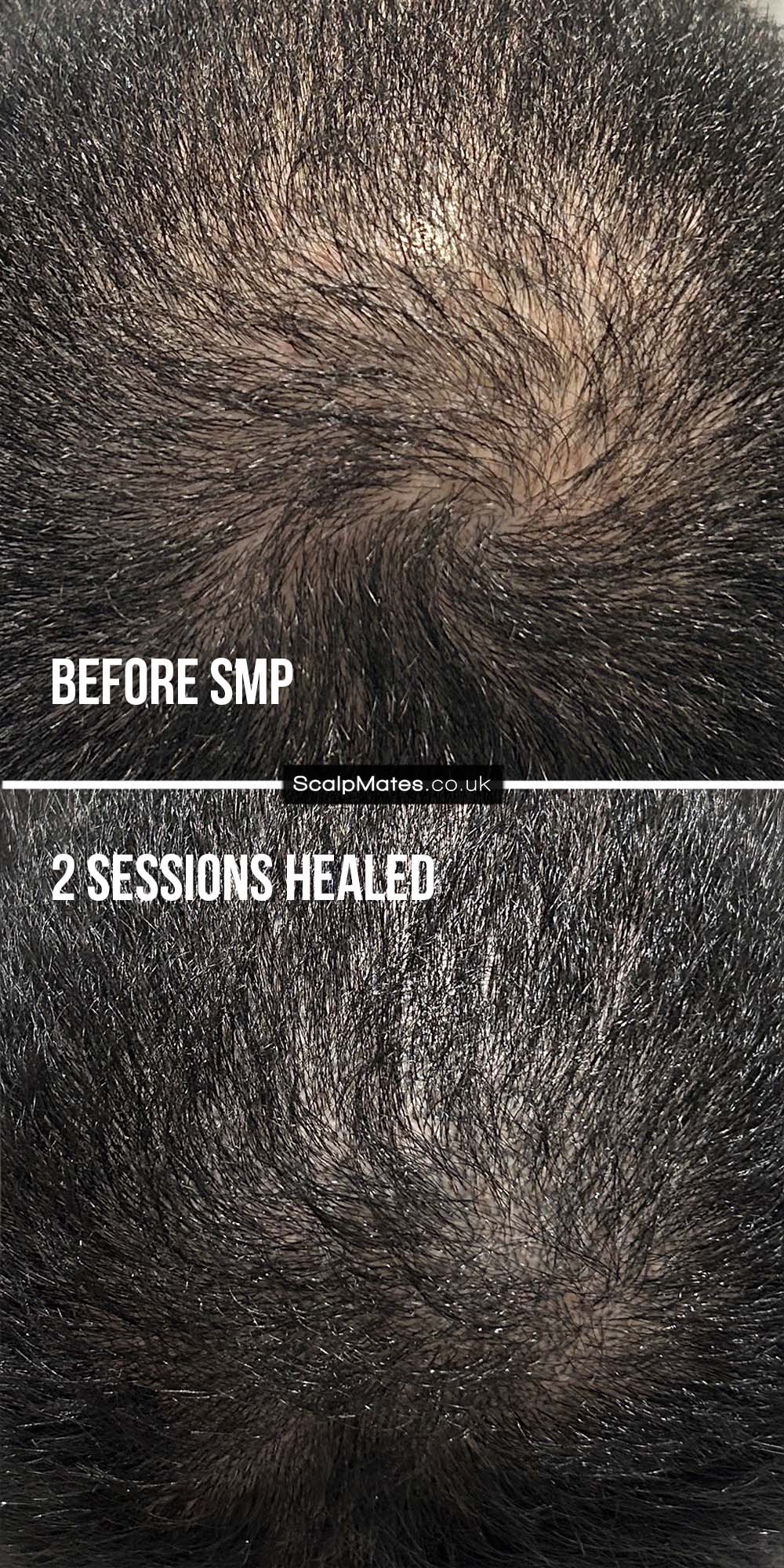
Close-up of the crown before treatment and after two healed SMP sessions. You can still see some scalp between the hairs, but the contrast has been reduced. The pigment is made up of small impressions rather than a solid dark patch.
The Treatment – Three Sessions Between February and March 2026
We completed the treatment over three sessions, with each appointment taking roughly 3–4 hours.
His hair had initially been considerably longer, but he trimmed it down to a more manageable length.
That made it easier for me to see the thinning areas properly, separate the hair and work between the existing follicles.
First Session – Building the Foundation
I started by working across the thinning areas on the top of his head, paying particular attention to the crown and hairline corners.
The goal of the first session wasn’t to make everything as dark as possible.
It was to establish a foundation of small, evenly distributed pigment impressions.
Once that first layer healed, we could see how much additional coverage was needed.
Second Session – Improving the Density
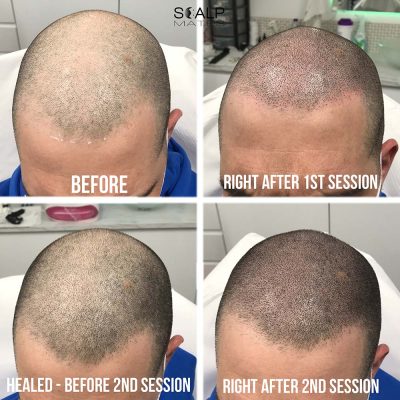
During the second appointment, I added another layer of pigment to improve the overall coverage.
This is where the appearance of density can become much more noticeable.
By building the treatment gradually, I can avoid making one area too dark compared with the rest.
He was extremely happy with how things looked after his second session.
The photographs you see throughout this case study were taken approximately 3–4 weeks later, once the skin had settled and he’d washed his hair normally.
Front hairline and temple area before treatment compared with two sessions healed. The aim was to reduce the visibility of the scalp while keeping the client’s natural hairline and existing hair intact. Photos taken in exactly the same spot, under the same spotlights, without any gimmicks.
A Slightly Embarrassing Moment Between Sessions
I should probably mention something that happened during this treatment.
We’d arranged his second appointment, but I somehow forgot to actually put it in my calendar.
So the poor man turned up for his session, and I had other plans!
Not my finest moment.
In all the years I’ve been doing SMP, this has only happened a handful of times, but it’s still incredibly embarrassing when it does.
Thankfully, he was very understanding and kindly agreed to reschedule.
I felt terrible about it, especially knowing he’d taken the time to come over from Solihull.
Third Session – Final Coverage Across the Top
After seeing how nicely the first two sessions had healed, we went ahead with a third session across the entire top.
This was to build on the existing work and improve the overall consistency of the density.
Unfortunately, I don’t have healed photographs after this final appointment.
So I want to be clear: the results shown in this article are from two fully healed sessions, not three.
He completed three sessions in total, but I’m not going to present the two-session photographs as something they’re not.
Why You Should Be Careful With Fresh SMP Before-and-After Photos
This is probably one of the most important things I can tell anyone considering SMP for thinning hair.
Always ask whether the results you’re looking at are fully healed.
I’m not saying that fresh photographs are useless. They’re great for showing the work immediately after a session.
But they don’t necessarily show what you’ll be living with a few weeks later.
When density SMP is freshly completed, there can still be excess pigment around the hair and on the surface of the scalp.
Even when the practitioner carefully cleans the area, the result can look considerably darker than it will once everything has healed.
The pigment hasn’t fully settled, the skin is still recovering and the hair hasn’t necessarily been washed normally yet.
All of this can create a temporary impression of much thicker hair.
Then, over the following weeks, the client washes their hair, the skin recovers and the true appearance of the pigment becomes clearer.
The result usually looks softer.
That’s completely normal.
But if you’re comparing a fresh SMP photograph with your own thinning hair and expecting exactly that level of coverage, you could be disappointed.
My advice is simple: ask to see photographs taken at least a few weeks after treatment, once the client has washed their hair multiple times.
Ideally, look for close-up photographs too.
That’s why I’ve included the crown close-up in this case study. It gives you a better idea of what the pigment actually looks like between the existing hairs.
How Much Does SMP for Thinning Hair Cost in Birmingham?
For this client, the equivalent treatment price in 2026 was £300 per session.
| Treatment | Price |
|---|---|
| Session 1 – Initial density coverage | £300 |
| Session 2 – Additional density | £300 |
| Session 3 – Final coverage across the top | £300 |
| Total for three sessions | £900 |
Not everyone with thinning hair needs exactly three sessions.
Some clients are happy with the improvement after two, while others may benefit from a third depending on how much scalp is showing, their hair colour and the amount of coverage they’re hoping to achieve.
In this particular case, he was already very happy after two sessions, but we completed the third for additional coverage.
The price for another client may differ depending on the size of the area, the amount of work required and their individual hair loss pattern.
Was the Treatment Painful? And Could He Return to Work?
Here’s a quick look at his treatment experience.
| Treatment experience | Details |
|---|---|
| Pain level | Around 3–4/10 |
| Numbing cream | Not needed |
| Session duration | Approximately 3–4 hours each |
| Sessions completed | 3 |
| Return to work | Next day |
| Comments from colleagues | None reported |
| Healed photographs | 3–4 weeks after session 2 |
| Client satisfaction | Very happy after two sessions |
| Regrets | None reported |
He was quite comfortable throughout the treatment and managed without any numbing cream.
He returned to work the following day and didn’t report anyone commenting on his scalp.
Of course, some clients experience more redness or sensitivity than others, so I always explain the aftercare and what to expect before they leave.
Does Density SMP Work for Everyone With Thinning Hair?
Unfortunately, no.
And this is where I think it’s important to be realistic.
If you have diffuse thinning but still have a decent amount of hair across the top, SMP can be a very useful way to reduce the visibility of the scalp.
But if you have a large, completely bald patch surrounded by longer hair, the situation becomes trickier.
Remember, SMP doesn’t create actual hair.
It creates the appearance of tiny hair follicles on the skin.
If there’s no real hair covering a large area, those pigment impressions won’t create the same texture or volume as the surrounding longer hair.
You could end up with a dark-looking patch of scalp surrounded by thick hair, which isn’t necessarily an improvement.
In cases like that, I may suggest keeping the hair much shorter or even going for a shaved-head SMP treatment instead (you can see how our 3-session shaved head process works).
It really depends on the individual.
And if I don’t think density SMP is going to give you a worthwhile result, I’d rather tell you before you spend your money.
Will SMP Damage the Existing Hair or Affect Future Hair Loss?
This is another question I get from people who want to keep their hair.
SMP is designed to deposit pigment into the upper layers of the skin, rather than into the deeper structures where the hair follicles sit.
When performed correctly, it shouldn’t damage the existing hair follicles.
However, SMP doesn’t stop hair loss either.
If your hair continues thinning, the appearance of your treatment can change over time.
That’s one of the reasons I’m careful about pigment darkness and dot size.
I always want to leave clients with options:
- Maybe they’ll keep their hair long for another ten years.
- Maybe they’ll eventually decide to shave it.
Either way, I don’t want today’s treatment to become tomorrow’s problem.
My Final Thoughts – Is SMP Worth It for Thinning Hair?
For this client from Solihull, I think density SMP was a very good option.
He had enough existing hair for the pigment to blend into, understood the limitations and wanted a realistic improvement rather than a completely new head of hair.
And that’s exactly the type of situation where I enjoy doing this treatment.
The healed photographs show a noticeable reduction in the amount of scalp visible through his hair, particularly around the crown and top (you can also view more real client results and case studies).
Is his hair suddenly as thick as it was when he was 18?
Of course not.
But does it look fuller, with less scalp showing through?
I think the photographs speak for themselves.
What I particularly like about this result is that we didn’t need to sacrifice the natural appearance of his scalp to achieve it.
Small dots, a carefully chosen shade and gradual layering made the difference.
If you’re considering scalp micropigmentation for thinning hair in Birmingham, Solihull or the surrounding West Midlands, feel free to send me a few clear photographs of your hair on WhatsApp.
I’ll give you my opinion on whether density SMP is likely to work for your particular hair loss pattern, what kind of improvement you can realistically expect and how much it would cost.
Laurentiu Bradea (Laur)
SMP Artist – ScalpMates Birmingham
scalpmates.co.uk